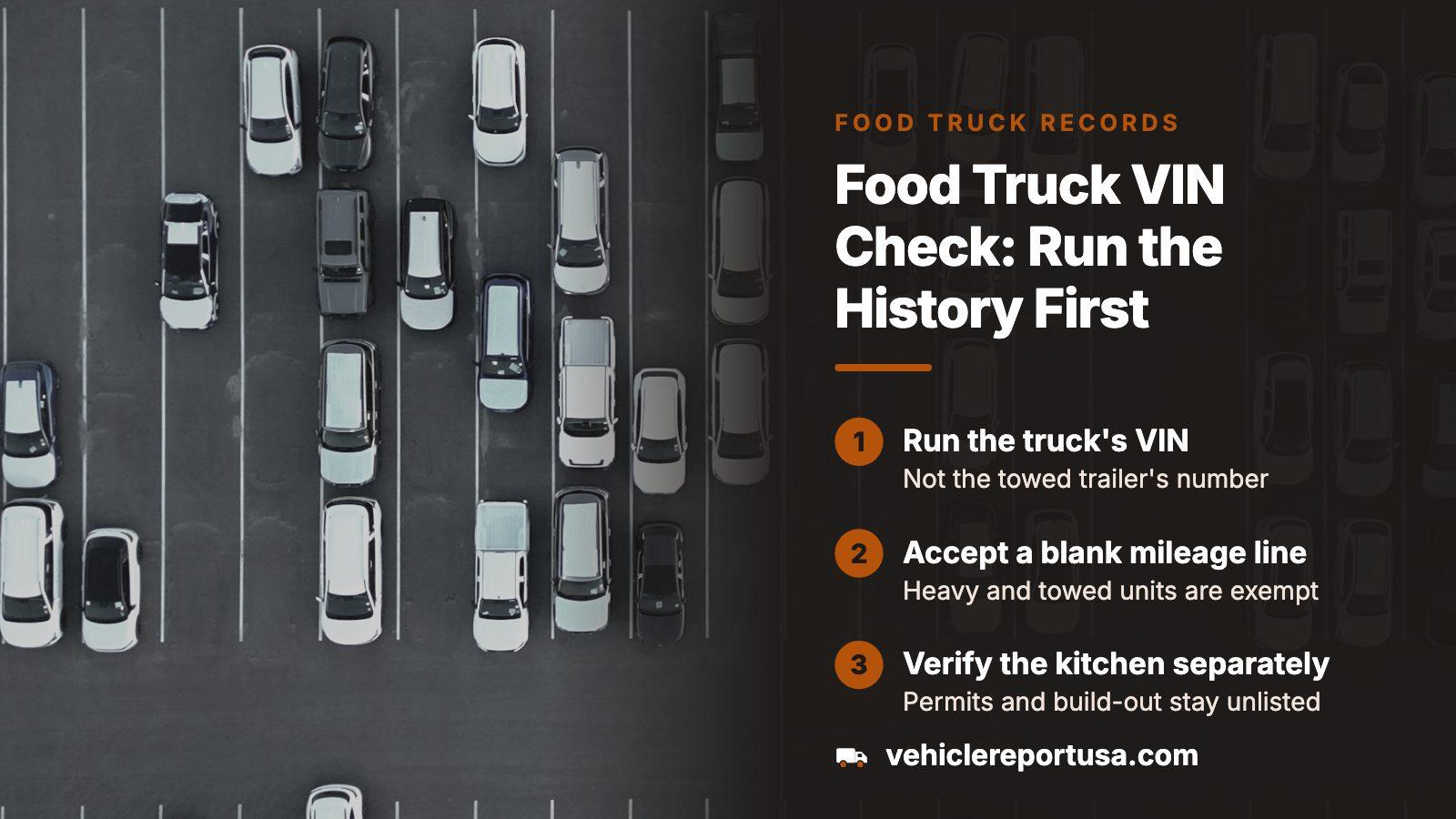
THE SHORT ANSWER
Start with the VIN and the free preview, then pay for one report per truck you are seriously weighing. You get title brands, damage and sale-lot history, mileage readings, lien and theft flags, plus unrepaired recalls. Kitchen equipment, permits and the build-out never appear in a vehicle database, and a heavy truck or a towed trailer can legally change hands without any mileage statement.
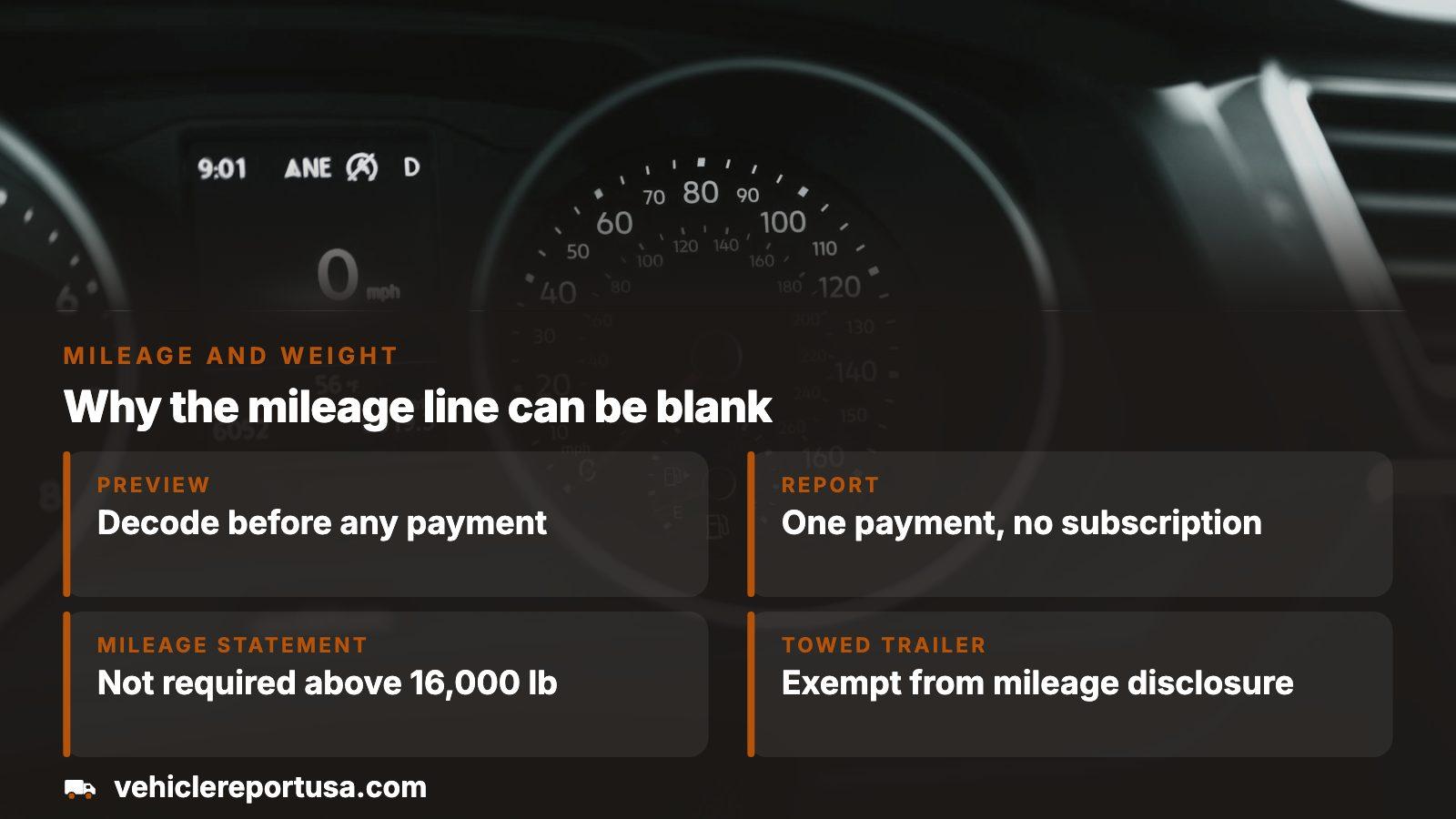
- Preview
- Free decode before any payment
- Report
- One payment, no subscription, packs available
- Mileage statement
- Not required above a 16,000 lb rating
- Towed trailer
- Exempt from mileage disclosure
What the check covers when the truck is also a kitchen
Sellers price a food truck by its menu, its equipment and its customer following. The vehicle gets less attention, yet it is the part that can strand you on a Saturday. A VIN report speaks for the chassis and the title, which makes it useful for a handful of entries:
- Title brands such as salvage, flood or junk, and any insurer total-loss entry.
- Mileage readings from past sales, lined up to spot a drop or a long gap.
- Auction and damage records, with sale photos of the cab and the body.
- Liens that could follow the truck to your driveway, and theft flags.
- Past use: rental, company fleet or one private owner.
- Open recalls against the chassis maker.
None of that tells you whether the kitchen passes a local inspection. Treat the report as the vehicle's background check and keep a separate list for the build-out.
Truck or trailer: pick the right number to run
A food business runs from either a self-propelled truck or a towed unit, and each has its own VIN. Federal rules in 49 CFR 565.15 say what the middle characters of that number must describe. On a truck they describe the make, model, chassis, cab style, engine, brakes and weight class. On a trailer they describe what kind of trailer it is, the body, how long it is and how many axles sit under it.
That gives you a quick sanity test. Decode the number in the free preview and compare the result with what you see: a trailer VIN that decodes to a different length, or a truck VIN that names a different engine, deserves questions before any money moves. Run the number printed on the title, then check it character by character against the plate on the vehicle itself.
Check digit
The ninth character of a modern VIN is a check digit: a formula run over the remaining sixteen produces it, and it appears as a numeral or an X. A single mistyped or altered character usually breaks it, so a failed decode is a reason to re-read the plate slowly, and a reason to ask the seller about it if the plate itself looks right.
Why the mileage line can be blank on a heavy or towed unit
Federal odometer disclosure rules in 49 CFR 580.17 skip several kinds of vehicle. A seller does not have to state mileage on a vehicle rated above 16,000 pounds, on anything that is not self-propelled, or on older models once enough years have passed. For a 2011 or newer model the wait is twenty years, counted from the start of its model year.
So a large step-van style truck may arrive with no signed mileage at all, and a food trailer never will. A thin odometer history on a heavy unit is not proof of fraud; it can simply be the law working as written. It does mean the dash reading is your only number, and you should weigh it against engine wear, tire condition and the service records the seller can actually produce.
| Situation | Mileage statement at sale |
|---|---|
| Rating above 16,000 lb | Not required |
| Towed trailer | Not required |
| 2011 or newer model, under 20 years old | Required |
| Sold directly by the maker to a US agency | Not required |
Red flags a food truck report can raise
Some patterns matter more on a truck that has spent years parked at events, idling behind a generator, or carrying a heavy kitchen load. Look for these in the report and in the seller's story:
- A brand from another state that the current title does not show.
- A lien the seller never mentioned.
- Auction photos showing damage the body no longer has, or a repaired rear end.
- A mileage record that jumps backward between two sales.
- A theft entry, or a VIN plate that looks newer than the vehicle around it.
Federal title-database material explains why the first item happens. A brand can vanish when the next state to issue a title never asks the first state what it recorded, and the federal page describes flooded vehicles hauled to places that do not brand them. Cloning is another risk: investigators in Operation Roadrunner recovered about 250 cloned, stolen vehicles, each carrying a VIN lifted from a lookalike.
Recalls on the chassis, and who answers for what
Recall records follow the chassis maker, and a food truck is often someone's converted chassis. NHTSA's recall data shows how that plays out. A 2010 Freightliner MT45 returns 2 campaigns, and a 2012 MT45 returns one, 13V634000. In that one, software on hybrid automated transmissions could raise engine speed during a downshift with no driver input, and dealers update the software free.
The other 2010 campaign, 10V472000, covered engines whose software could mishandle aftertreatment fault codes. The software might stop a vehicle unexpectedly, or leave it running while the device overheats, which raises fire risk. Both are the kind of item a report should list as open or closed. Expect a result of zero for plenty of years, since a lookup that returns nothing, as it did for a 2005 MT45, simply means no campaign is on file for that make, model and year.
Limits of a recall lookup
A recall record covers the truck's chassis and engine. It does not cover the kitchen, the propane system or the generator, which come from other suppliers and are not tracked by the VIN.
How to run the check, and what it costs
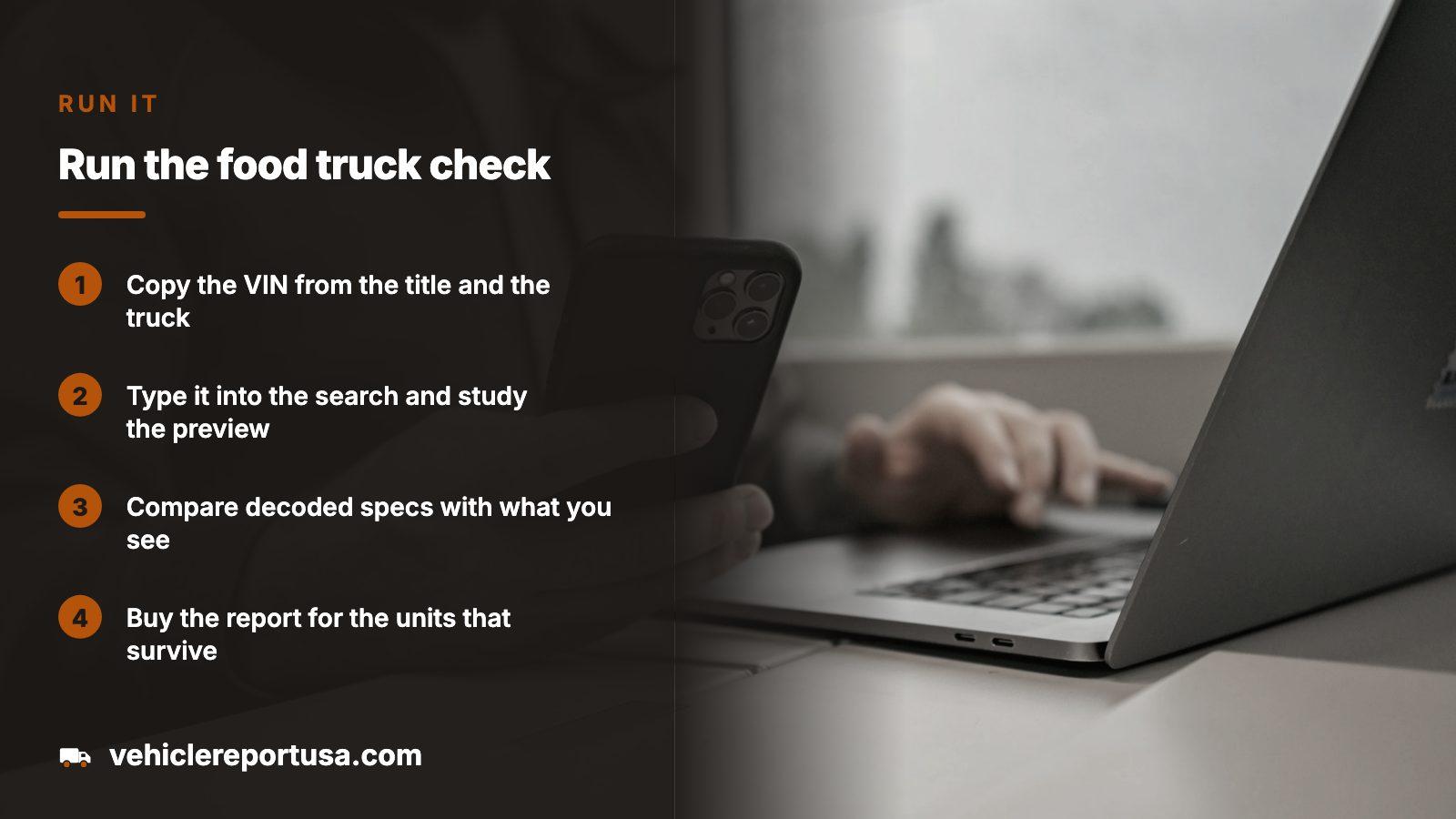
- Copy the VIN from the title, then read the same number off the vehicle's own plate.
- Type it into the search on this page and study the free preview, which decodes the truck or trailer.
- Compare the decoded specs with what you see in person.
- Buy the one-time report for the units that survive, and read every section before you negotiate.
The preview carries no charge. When you want the full record, one purchase buys one report and nothing renews later; bundles exist for people comparing several trucks. Amounts live on the pricing page.
What to do once the report is in
Even a clean report only shrinks the risk. Pay a diesel or fleet mechanic to inspect the frame, brakes and tires, and ask a separate specialist to look at the propane lines and electrical system. Ask the seller for the title, the lien release if there was one, and the service history, then hold the truck to what the paperwork says.
A report that shows a brand, an unexplained mileage drop or a lien changes the price conversation, or ends it. Food rules vary by place, and the FDA Food Code is a model that state and local regulators adapt, so ask your own health department what a truck must have before it can serve. Do that before you buy, since a vehicle that cannot be licensed locally is hard to resell.
Where this information comes from
- 49 CFR 565.15: VIN content requirements — what each section of a truck or trailer VIN must encode, and the check digit
- 49 CFR 580.17: odometer disclosure exemptions — which vehicles can be sold without a mileage statement
- Bureau of Justice Assistance: NMVTIS for consumers — title brands, flood vehicles moved between states and VIN cloning
- NHTSA: recall records by vehicle (API) — campaign numbers, components and remedies for the MT45 chassis
Sources and photos: Facts checked against the sources above in November 2026. Photos by Iain, Anastasiia Nelen and Nathan Dumlao on Unsplash; diagrams by VehicleReportUSA.
Keep reading
- Box Truck VIN Check: Run the History Before You Buy OneMany mobile kitchens ride on a box truck chassis, with the same weight and paperwork questions.
- Step Van VIN Check: Run the History Before You Buy a Used Walk-In VanThe walk-in van body is a common base for a kitchen build.
- Trailer VIN Lookup: Check a Used Trailer's History by VIN Before You PayIf the kitchen is towed, start with how trailer VINs work.
- Check a Truck VIN Number: Pickups, Box Trucks and Heavy-Duty RigsThe general truck walkthrough covers brands, liens and mileage in more depth.
Frequently asked questions
Can I check a food truck VIN for free?
Part of it. The preview here decodes the vehicle without payment, and NHTSA's recall tool costs nothing. Brands, damage records, liens and theft flags sit in the paid report, a one-off purchase with no renewal. Neither tool looks at the kitchen equipment.
Does a VIN check cover the kitchen equipment?
No. A vehicle report follows the chassis and the title, not the appliances bolted into the body. Ask for equipment receipts and service records, and have an outside specialist test the gas and electrical systems before you hand over any money.
Does a food trailer have its own VIN?
Yes. Trailers carry a VIN of their own, and federal rules say its middle characters must describe the kind of trailer, its body, its length and its axles. Run the number on the trailer's plate, not the tow vehicle's, and compare the decoded length with a tape measure.
Why does the report show no mileage for my truck?
Heavy vehicles rated above 16,000 pounds, towed units and sufficiently old models can be sold without a mileage statement, so earlier sales may have no reading on file. Read the dash number against tire wear and service records instead.
When should I run the VIN, relative to the test drive?
Ahead of it. If the VIN carries salvage history, a lien or a theft flag, you save yourself the trip, and the preview takes about a minute. Start from the number on the title and bring the results along to the inspection.
Now check the car itself
The guide explains what to look for. The report shows what this VIN has on record.