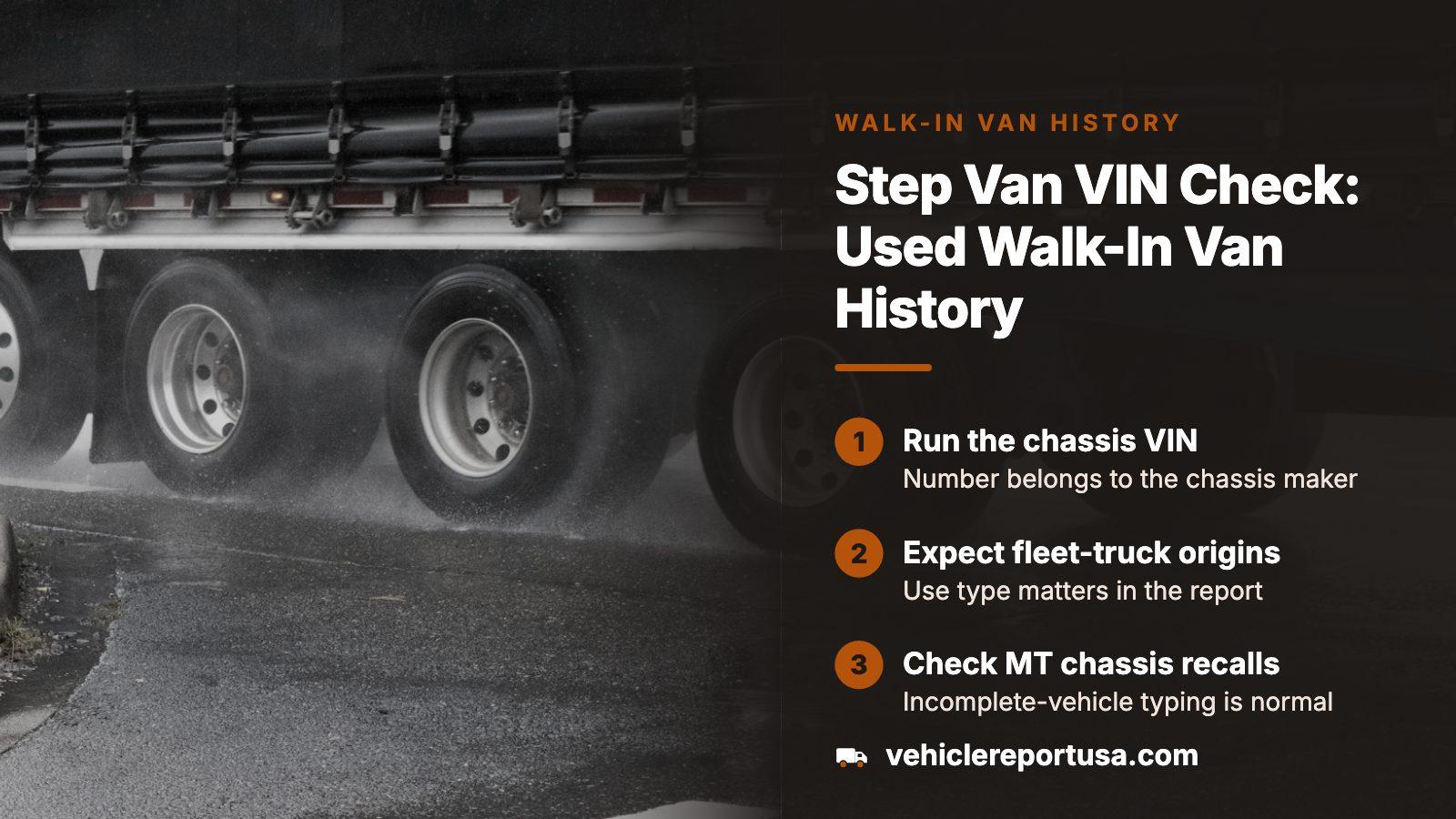
THE SHORT ANSWER
Find the VIN on the van, enter it in the search field and read the preview, which costs nothing. After that, decide whether the report is worth buying; it adds title brands, accident and salvage entries, odometer readings, liens, theft flags, ownership and use type, and open recalls. Step vans often start as fleet trucks, so the use-type and ownership lines deserve the closest read.
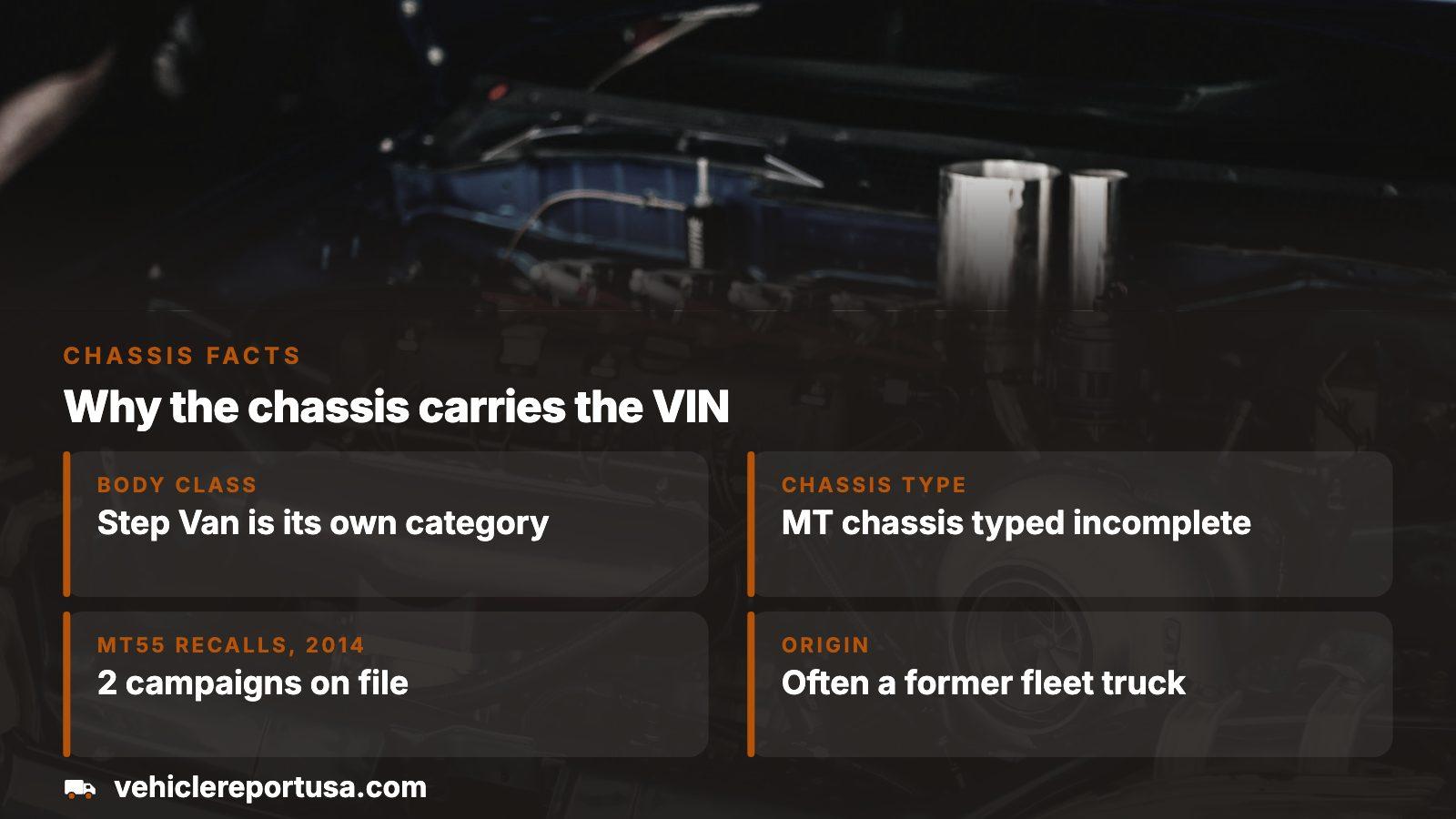
- Body class in vPIC
- Step Van/Walk-in Van is its own category
- Chassis type
- Freightliner MT chassis are typed Incomplete Vehicle
- MT55 recalls, model year 2014
- 2 campaigns, 13V634000 and 13V640000
- Free preview
- Yes; the full report is paid once
What a step van check finds that a walk-around cannot
Step vans are built to be driven hard and parked in a different spot every night. A bakery route, a parcel contract and a uniform-service loop all leave the same sort of van on the used lot: clean paint, a swept cargo floor, and a history nobody mentions. The VIN lookup is how you read that history without taking the seller's word.
- Brand wording on the title (salvage, rebuilt, flood), which moves the van's value and its insurability.
- Crash and damage entries, along with auction or salvage listings that carry pictures from before repair.
- Dated odometer readings, which let you judge whether the miles rise at a plausible pace.
- Liens and impound entries that could stop a clean transfer.
- Ownership and use type, which is where a former fleet vehicle shows itself.
None of this replaces a mechanic. A history report is paper. It says nothing about a rusted floor, a worn bulkhead door or a tired hybrid battery.
Why the VIN on a step van belongs to the chassis
Most step vans are two-stage builds. A chassis maker supplies the frame, engine and cab area, and a body builder adds the walk-in box. NHTSA's decoder reflects this: Freightliner appears under several vehicle types, and one of them is Incomplete Vehicle, the label for a chassis sold before the body goes on.
That matters when you read results. A decode of a Freightliner M2 chassis number, for example, came back with Daimler Truck North America as the manufacturer and Incomplete Vehicle as the type, and it reported that the ninth-position check digit was correct. Expect the same kind of answer for a walk-in van: the maker named is the chassis builder, not whoever built the box.
| Chassis name in NHTSA's list | What it is |
|---|---|
| Freightliner MT 35, MT45, MT 55 | Walk-in van chassis from the Freightliner Custom Chassis line |
| Freightliner MT 45G, MT 55G | Front gasoline engine versions of the walk-in van chassis |
| Freightliner MT-50E | Electric front engine van chassis |
| Workhorse W42, W62, P32, P42 and others | Workhorse chassis models in the same database |
| Utilimaster Aeromate | A Utilimaster model listed by NHTSA |
Getting the number off the van
Ask the seller to let you read the number yourself, standing next to the van. Look at the metal plate on the dash by the windshield and the certification sticker in the driver's doorway, then match both against the title. Photograph each one. If a listing shows only a plate or a stock photo, ask for the VIN in writing before spending time on the van.
Because body and chassis come from different builders, a body plate that differs from the chassis number can be innocent. Disagreement among the dashboard, the doorway label and the title is another matter. Pause the deal until someone explains it.
- Copy the 17 characters exactly, with no spaces.
- Paste them into the VehicleReportUSA lookup box and open the preview.
- Check that the preview's make, model and year describe the van you are standing next to.
- Pay for the report only when they agree.

Recalls worth knowing on Freightliner MT chassis
Walk-in vans on Freightliner's MT55 chassis have a real recall trail in NHTSA's database. The list below comes from the federal recalls API for that model name. Your van may or may not fall inside a build window, so the VIN check is what tells you whether a campaign applies to it.
| Campaign | Model years | Problem | Fix |
|---|---|---|---|
| 09V451000 | 2008 to 2010 | A dash switch could let the driver block particulate filter regeneration on certain Cummins diesels | Daimler working with Cummins on a free repair |
| 10V247000 | 2010 and 2011 | Park may not engage on certain Eaton hybrid transmissions | Eaton performs the free remedy |
| 13V634000 | 2009 to 2014 | Hybrid transmission software could raise engine speed on downshifts without driver input | Dealer software update, free |
| 13V640000 | 2014 | Wrong calibration could make the speedometer read low | Dealer software update, free |
| 15V620000 | 2016 | Engine control module could short and stall the engine without warning | Dealer replaces the module, free |
A recall that was never performed is a negotiating point and a safety question. Ask the seller for the dealer paperwork that closes it.
What owners say once the van is in service
From an NHTSA owner complaint
An owner of a 2016 Freightliner MT55 told NHTSA that a batch of turn signal switches supplied to them had a failed left rear output. The driver got no warning light, so a dead signal could go unnoticed. The only marking they could find on the part was MPR. No crash, fire or injury was reported.
The lesson for a buyer is small but practical. Electrical faults on a work van can sit quietly, so test every lamp and signal on the lot, and check the lighting component of any open complaint for that model year.
Reading the results and the red flags
- A salvage, rebuilt or flood brand: price the van as damaged goods, or leave.
- Odometer entries that go backward or stall for a long stretch.
- A lien or impound entry the seller has not explained.
- A theft record, which should end the conversation until it is cleared in writing.
- Use type that says rental, taxi or commercial fleet when the seller called it a one-owner van.
- An open recall on the hybrid drivetrain or the engine electronics.
Fleet history is not bad in itself. Regular service at a fleet shop can be a good sign. What you want is a story that matches what the seller told you.
Where a history report stops
The federal NMVTIS program was created to protect buyers against title scams and unsafe trucks, and to block resale of stolen ones. States and police use it against title crime too. Reports draw on what states, insurers and salvage yards report, so a repair paid in cash at a back-lot shop may leave no record.
That is why the report goes beside a pre-purchase inspection, not in place of one. Ask a diesel or truck shop to look at the frame rails, the step well, the roll-up or sliding door, the brakes and any hybrid components, and to read any stored fault codes.
Cost, and your move after the preview
Viewing the preview is free of charge. Beyond it, a single payment covers a full report for one van, nothing renews, and amounts are listed on the pricing page. Shopping across several vans? A multi-report pack exists for that.
A sensible order
Run the preview on every van you are considering, buy the report on the one or two you would actually test drive, then book the inspection. A clean report plus a clean inspection is the combination to pay for.
Where this information comes from
- NHTSA vPIC: Body Class values — shows Step Van/Walk-in Van as a body class
- NHTSA vPIC: Freightliner models — lists the MT chassis names
- NHTSA recalls API: Freightliner MT55 — campaign numbers, dates and remedies
- NHTSA owner complaint 11627617 — owner experience, paraphrased
- VehicleHistory.gov: NMVTIS for consumers — what the federal title system is for
Sources and photos: Facts checked against the sources above in November 2026. Photos by fr0ggy5, Alejandro Escamilla and Willian Cittadin on Unsplash; diagrams by VehicleReportUSA.
Keep reading
- Box Truck VIN Check: Run the History Before You Buy Onethe closest relative if the van is a straight truck with a cargo box
- International Truck VIN Check: Isuzu, Hino and Dump Truck Historyfleet history and use type for work vehicles in general
- Truck Recall Check by VIN: Find Open Recalls Before You Buyhow to look up open recalls for a truck by VIN
- Food Truck VIN Check: Read the Vehicle's History Firstmany food trucks are converted step vans
Frequently asked questions
Does a step van have a normal 17-character VIN?
Yes. Walk-in vans built in modern years carry a 17-character VIN like any other highway vehicle, and NHTSA's decoder can validate the check digit. The number usually identifies the chassis, since the body is added by a second company.
Can the check tell me if a step van was a delivery fleet vehicle?
Often it can. The report lists ownership and use type, and entries such as commercial or fleet use suggest hard daily service. It will not show route mileage or how the van was loaded, so pair it with a service-record request.
Will the check show open recalls on my step van?
Open recalls attached to the VIN appear in it. NHTSA's database has campaigns for Freightliner MT55 chassis, but each one covers only a build window, so the VIN is what decides whether yours is included.
Does the preview cost anything?
Nothing is charged for the preview, which only asks for the VIN. A full report is bought separately, singly or in a pack, with no recurring plan. See the pricing page for amounts.
What if the body plate and the chassis VIN do not match?
A body builder's plate can differ from the chassis number without anything being wrong. If the dashboard plate, the doorway label and the title contradict one another, get the seller to account for it before any money moves.
Now check the car itself
The guide explains what to look for. The report shows what this VIN has on record.