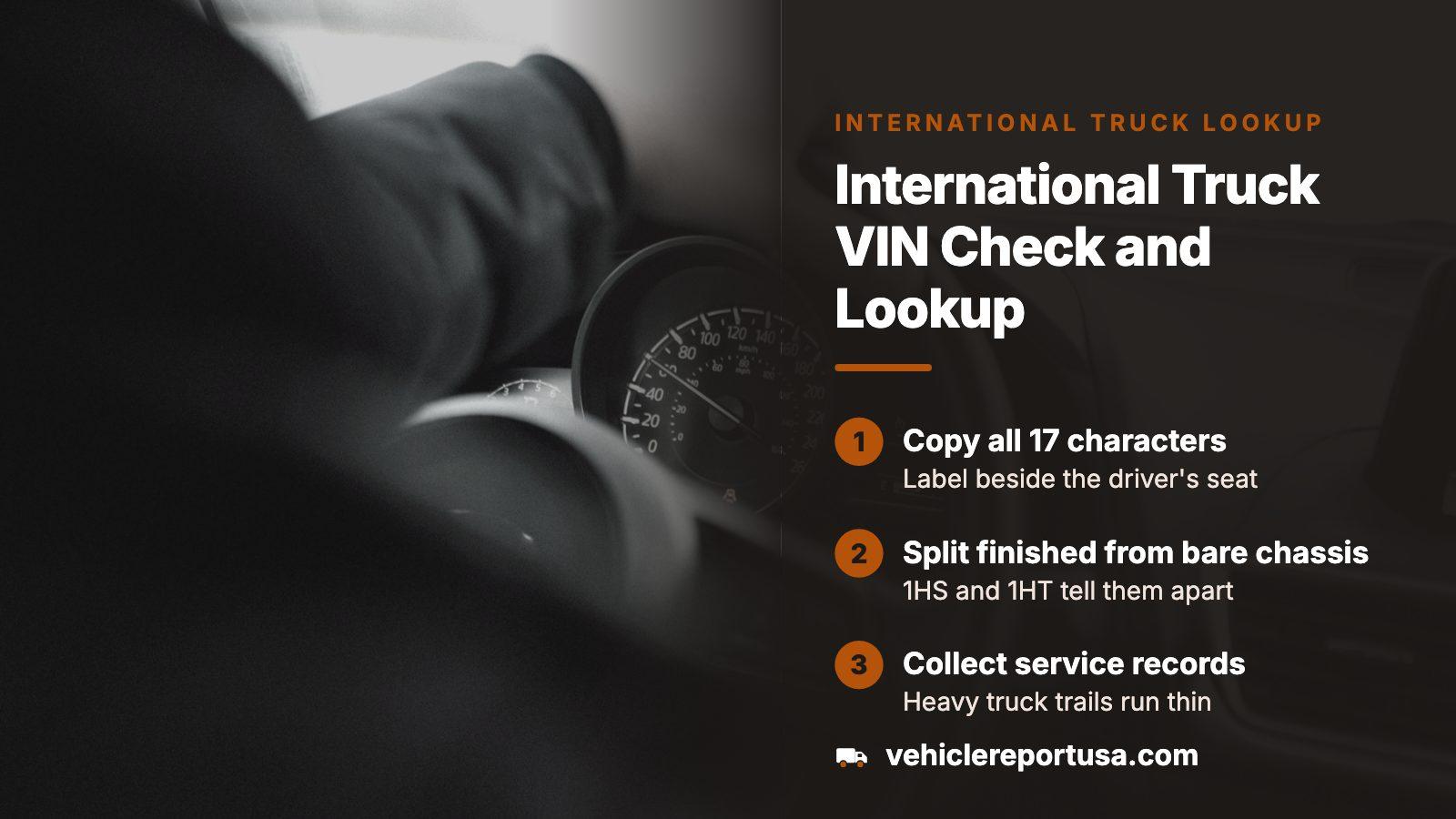
THE SHORT ANSWER
To look up an International truck by VIN, copy all 17 characters from the label beside the driver's seat and run the free preview. The opening three characters identify International and say if the number came from a finished truck or a bare chassis. The paid report then searches for title brands, auction photos, odometer readings, theft and open safety recalls. Heavy trucks leave thin paper trails, so pair the result with service records and a shop inspection.
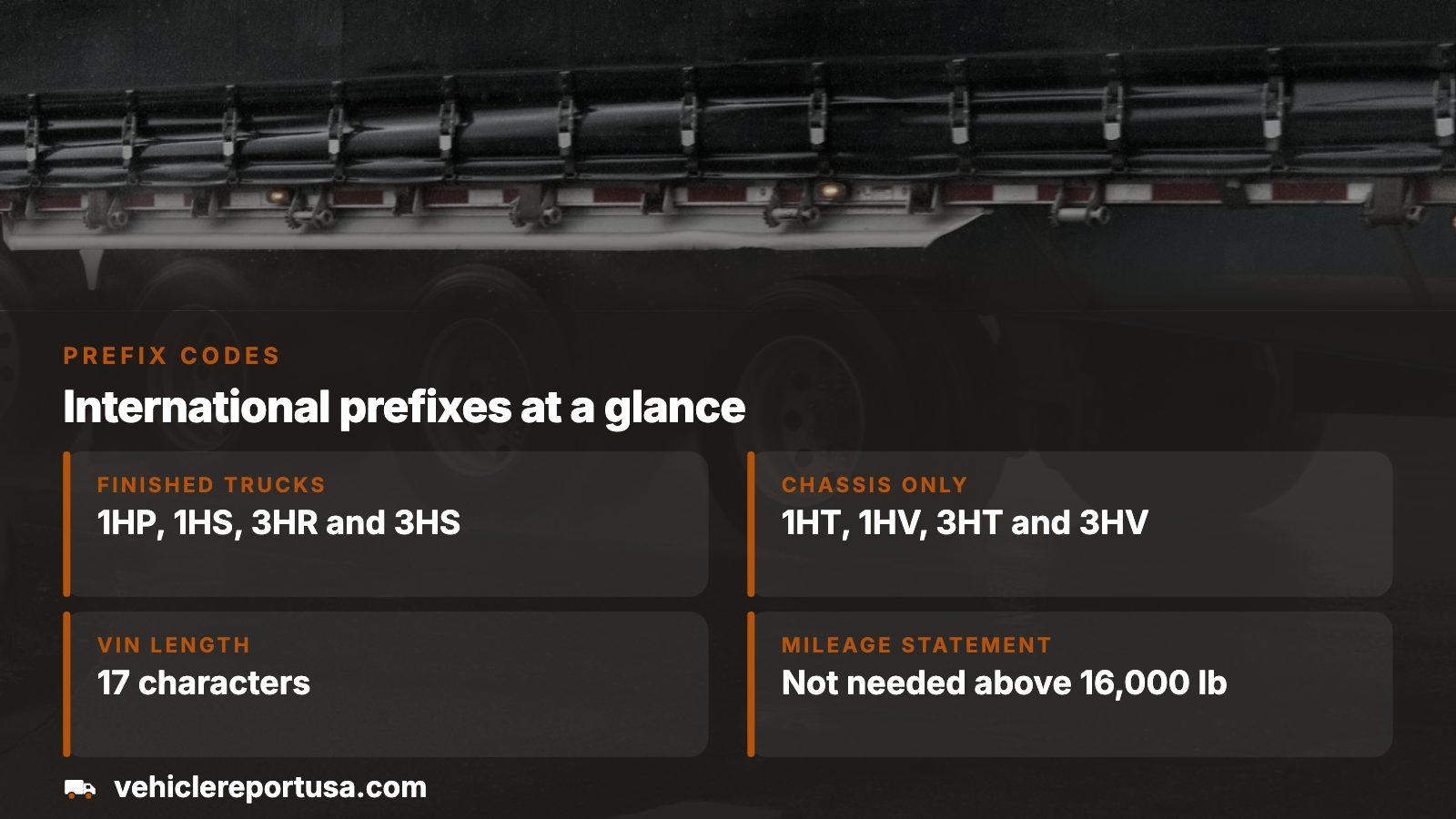
- VIN length
- 17 characters
- Finished truck prefixes
- 1HP, 1HS, 3HR and 3HS
- Chassis-only prefixes
- 1HT, 1HV, 3HT and 3HV
- Mileage statement
- Not required above 16,000 lb
What a history check finds on a used International
Most International buyers are looking at a tractor or a vocational truck that spent years in someone's fleet. A VIN history cannot tell you how the clutch feels. What it can do is show the things a seller may not volunteer: a flood or salvage label on the title, a stop at an insurance auction, a lien still sitting on the record, a theft entry, or a mileage reading that sits oddly beside the one on the dash.
It also pulls open safety recalls tied to that exact number, which matters on this make because several engine campaigns have run for years across the LT and RH lines.
Where this check fits
Think of it as the paperwork half of an inspection. It screens out trucks with a bad past before you pay a mechanic to look at the present.
Reading the first three characters: 1HS, 3HS and the chassis codes
NHTSA's register holds a short list of identifiers for International Motors, LLC. Which one opens your VIN says where the truck was assembled and whether it left the plant finished.
| Prefix | How NHTSA lists it | Built in |
|---|---|---|
| 1HP, 1HS | Truck | United States |
| 1HT, 1HV | Incomplete vehicle | United States |
| 3HR, 3HS | Truck | Mexico |
| 3HT, 3HV | Incomplete vehicle | Mexico |
An incomplete vehicle is a chassis that a body company finished, so a dump body, reefer box or tow bed may carry its own paperwork. Federal rules also say the fifth-to-eighth section of a truck VIN must let the maker's filed data identify model, series, cab and engine type, which is why a decoder can turn those characters into specs.
Finding the number on the truck itself
Start at the driver's door. Under federal rules the maker's certification label sits on the door pillar, latch post or door edge beside the driver, and it is riveted or bonded so removal destroys it. A label that is missing, scratched or peeling deserves a direct question to the seller.
- Copy the full 17 characters from the label, then read them again against the title and the registration.
- Look at the number stamped or plated on the cab or frame and confirm it matches the label.
- On a chassis finished by a body builder, expect a second label from that builder with its own name and weight ratings.
- Photograph every plate before you leave the lot.
Character nine is a check digit. It exists to catch copying mistakes, so a VIN that fails the check usually means a typo, though a tampered plate can fail it too.

Recalls on International trucks: look up the engine campaigns first
NHTSA's recall data for the LT shows how crowded a model-year list can get: 17 campaigns for 2018, 18 for 2019, 9 for 2020 and 13 for 2021. Each one applies only to certain trucks, so the VIN is what separates a live problem from noise.
| Campaign | Trucks named | Problem |
|---|---|---|
| 20V255000 | 2018-2020 LT, 2019-2020 RH | Wrist pin bushing in the connecting rod may fail and shut the engine down |
| 21V281000 | LT and RH, model years 2019 to 2021 | Pin can crack; trucks given only the first software fix must return |
| 22V691000 | 2018-2021 HV and LT, 2018-2020 HX, RH | Pin may crack; dealers add knock detection and replace rods as needed |
| 21V112000 | 2021 LT with Cummins X15 | Flywheel capscrews may be under-torqued, so the flywheel can detach |
From an NHTSA owner complaint
An owner who bought a 2018 LT said repeated shop visits were billed for what proved to be a calibration software campaign, and the fault stayed. A second shop could not find the cause. Only later did the owner find the connecting rod recall on NHTSA and see that it matched the symptoms.
The lesson: look up open campaigns by VIN before paying for diagnosis, and ask whether the rod remedy was finished or only the warning software was installed.
Mileage on a heavy truck needs more proof than a dash reading
The federal odometer rule exempts any vehicle rated above 16,000 pounds from a written mileage statement at sale. A Class 8 International is rated at 33,001 pounds and over, so the paper trail for its miles may simply not exist. The number on the cluster is therefore a claim, and the history is how you test it.
From an NHTSA owner complaint
A dealer who sold a 2021 LT625, along with several others, to a fleet dealer reported that the trucks had about 600,000 miles at sale. The buyer then advertised them at about 300,000. The seller matched the VINs and photos to the new listings.
One complaint proves nothing about the market, but it shows how a halved figure can travel. Compare every reading in the report, including any from title transfers and auctions, then ask for service invoices and engine hour data that tell the same story.
Title brands, washed titles and cloned numbers
The Justice Department's NMVTIS pages explain what a brand is: a label a state assigns for a vehicle's condition, such as junk, salvage or flood. Retitle a truck in a state that never consults the earlier record and the brand can drop off, a practice known as washing.
The same pages describe cloning, where thieves put a real VIN, copied from a twin sharing its make, model and year, onto a stolen truck. A clean-looking report cannot expose a clone by itself, so confirm that the plate, the label and the title all agree, and that the truck matches the specs the VIN decodes to.
- Ask which states have titled the truck.
- Check whether the report lists an insurance total loss or a salvage yard transfer.
- Compare the decoded engine and axle setup with what is under the hood.
Red flags worth raising before you pay
- A door label that is missing, painted over or looks newer than the cab.
- A VIN whose decode gives another model year or engine than the ad states.
- Mileage that drops between two records, or a seller who will not show service invoices.
- An open engine recall the seller has never heard of.
- A title from a state far from where the truck worked, with a brief ownership gap.
- A price well below similar trucks with no explanation.
No single item proves fraud. Stack two or three and you have grounds to leave, or to book an outside inspection and bring the report along.
Running the check and what it costs
Type the VIN into VehicleReportUSA and a no-cost preview appears first, enough to confirm make and model year before you spend a cent. Buying the full report is a single purchase, and a 3, 5 or 10 pack makes sense if you are comparing several trucks. Nothing renews. Current prices are on the pricing page.
Run it ahead of the test drive. A brand or a mileage conflict in the report saves you a day on the road. If it comes back clean, you still owe the truck an inspection, a look at the recall lookup on NHTSA, and a ride with the service records on the seat beside you.
Where this information comes from
- NHTSA owner complaint 11770753 — owner experience, paraphrased
- NHTSA owner complaint 11610070 — owner experience, paraphrased
- NHTSA vPIC: VIN decoder — the register behind the prefix table and partial-VIN decoding
- NHTSA recalls API: International LT — campaign counts, trucks named and remedies
- Vehiclehistory.gov: NMVTIS for consumers — brands, washing and cloned vehicles
- eCFR: 49 CFR 580.17 — odometer disclosure exemptions by weight
- eCFR: 49 CFR 567.4 — where the maker's label goes on the truck
Sources and photos: Facts checked against the sources above in November 2026. Photos by Miles Loewen, Cole Keister and fr0ggy5 on Unsplash; diagrams by VehicleReportUSA.
Keep reading
- Semi Truck VIN Check: Run a History on a Used Class 8 TractorClass 8 tractors from any maker: label spots, mileage gaps and open campaigns.
- International Truck VIN Check: Isuzu, Hino and Dump Truck HistoryFleet history, liens and records on trucks that worked for a living.
- Freightliner VIN Check: Read a Truck's History Before You PayCompare another large maker's prefixes and recalls before choosing a tractor.
- Truck VIN Lookup Specs: What the Decode Shows and Where It StopsSee what a decoded truck VIN says about engine, axles and weight rating.
Frequently asked questions
Can I run an International truck VIN lookup for free?
NHTSA's decoder and recall lookup are free of charge and return specs and open campaigns, and the VehicleReportUSA preview carries no charge either. Brands, auction photos and odometer history come with the paid report, bought once.
Where is the VIN on an International truck?
Look at the certification label near the driver's seat, on the door pillar, latch post or door edge. On a body-builder chassis there may be a second label from the builder, so match both to the title.
Does a VIN check show the true mileage on an International?
It shows the readings that were recorded. Trucks over 16,000 pounds need no mileage statement at sale, so gaps are common. Compare every reading and ask for service invoices and engine hours.
Which International recalls matter most on a used LT?
The connecting rod campaigns stand out: 20V255000, 21V281000 and 22V691000. Ask whether the full remedy was done or only the warning software was installed, and look the VIN up on NHTSA.
What do 1HS and 3HS mean at the start of a VIN?
Both identify International trucks in NHTSA's register. The leading 1 marks a truck built in the United States, and the leading 3 marks one built in Mexico. Chassis codes use T and V as the third character.
Now check the car itself
The guide explains what to look for. The report shows what this VIN has on record.