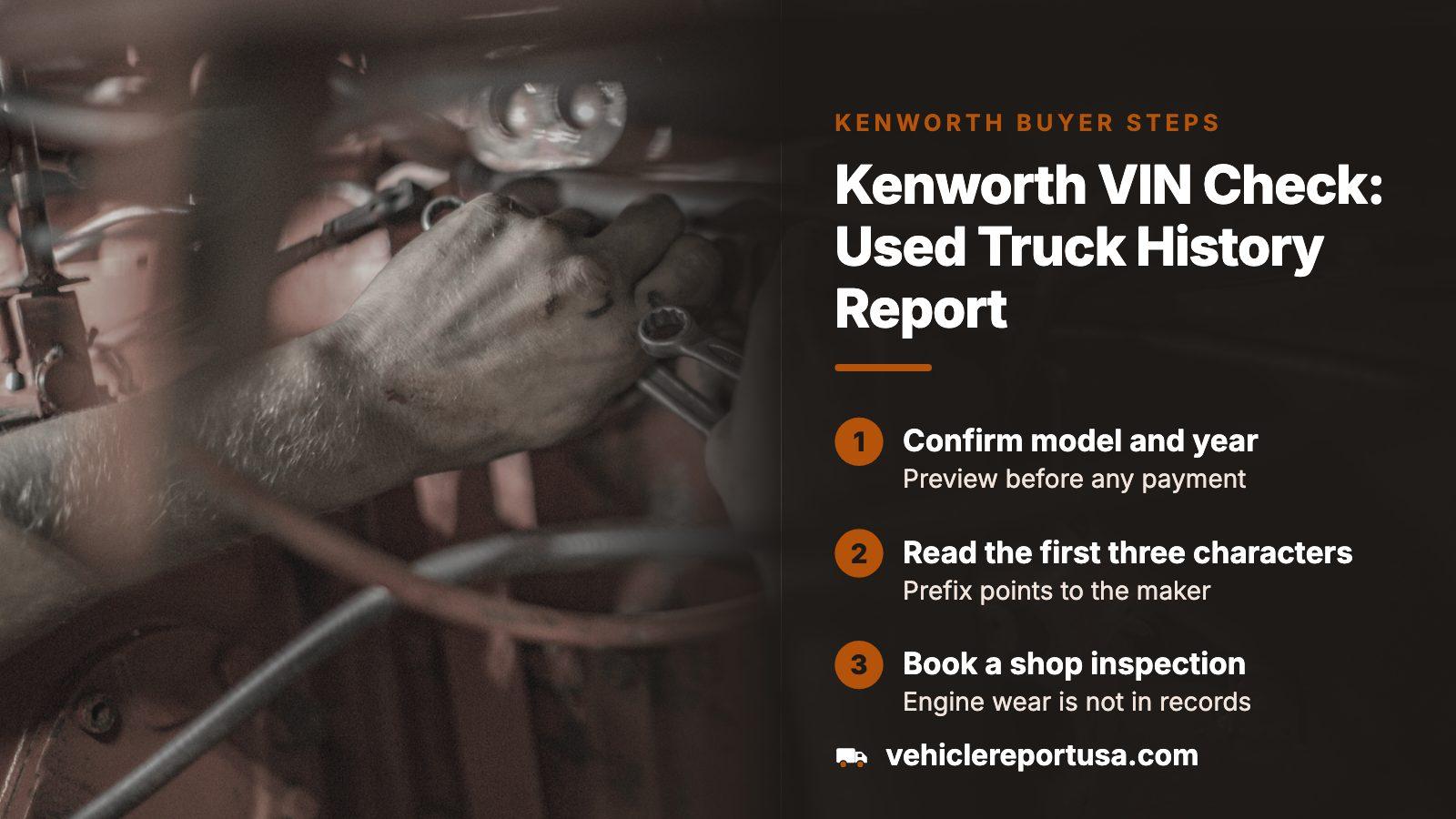
THE SHORT ANSWER
Put the VIN into the search box and look at the free preview to confirm model and year. After that, one payment buys the full record for any truck you still want: branded titles, damage with auction photos, odometer entries, lender claims, theft flags and unclosed recalls. Engine wear is not in there, so book a shop inspection too.
- Preview
- Free decode, nothing to pay
- Report
- One payment, no subscription
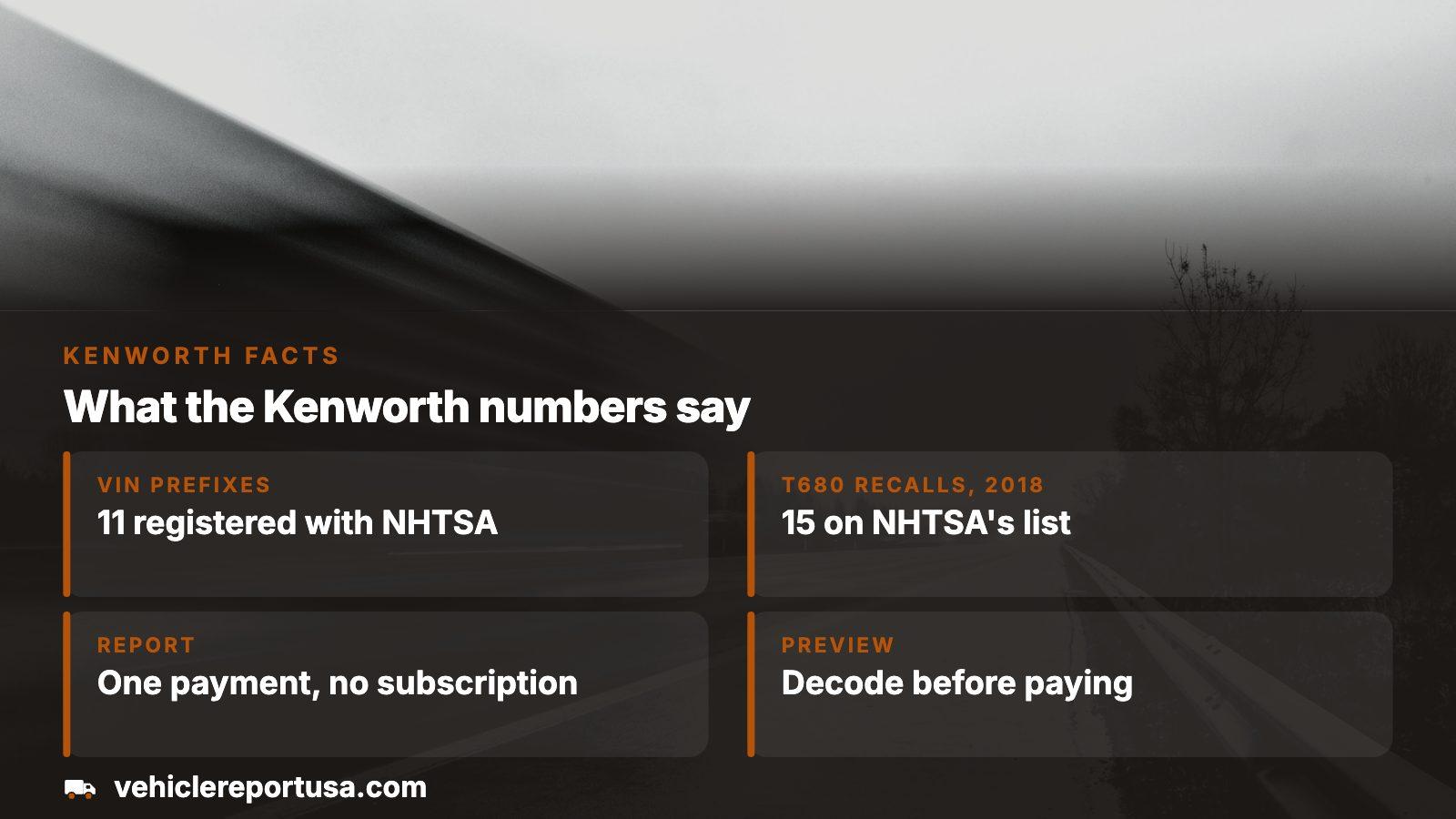
- Kenworth VIN prefixes
- 11 registered with NHTSA
- T680 recall campaigns, 2018
- 15 on NHTSA's list
What a history check covers on a Kenworth
Heavy trucks lead busier lives than pickups. A day cab may have hauled gravel for one company, then gone through an auction and ended up with an owner-operator three states away. Each hand-off leaves a line in the record, and the VIN is what ties the lines together. For a Kenworth, these are the entries worth your time:
- Brands on the title (salvage, junk, flood) and any insurance write-off.
- Damage records and auction listings, often with photos of the cab corner, hood and front axle.
- Odometer readings logged at sales and registrations, so a backward step or a silent stretch shows up.
- Liens and impound entries that could block a clean transfer.
- Theft records and insurance claims.
- How the truck was used and how many owners it has had.
- Recalls that a dealer has not yet closed out.
None of that tells you how the engine was serviced or whether the frame was pulled straight. Think of it as a cheap screen that drops the worst trucks before a diesel shop bills you for an inspection.
Free preview first, one payment for the report
VehicleReportUSA works in two steps. The preview decodes the number and shows you what the record holds, at no charge, so you can confirm the truck matches the listing. If it does, you buy a single report. No account subscription, no renewal. Shopping several trucks? Multi-report packs exist, and current rates are on the pricing page.
The decode preview is the free part. The report itself is paid, which deserves a plain statement because many sites advertise a free history and charge at the final screen.
Getting the right number off the truck
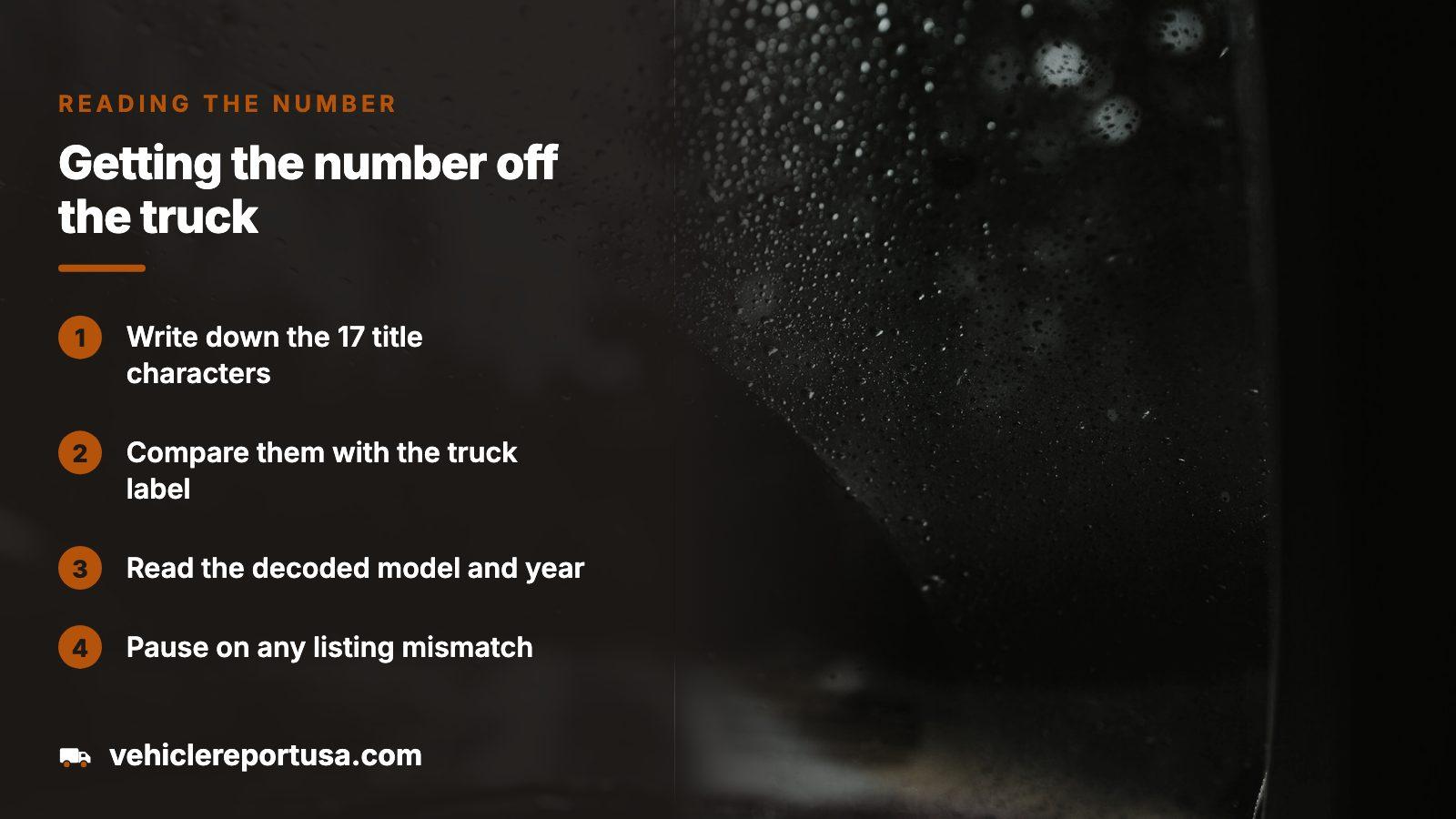
Start with the seller's paperwork, but verify against the metal. The title and registration list a VIN, and so does the certification label on the cab door area. Photograph the label and read the characters yourself instead of trusting a typed listing.
- Write down the 17 characters printed on the title or registration.
- Compare them with the label on the truck, character by character.
- Type them into the search box and read the decoded model and year.
- Any mismatch with the listing is a reason to pause and question the seller.
Engines, transmissions and axles carry serial numbers of their own. Those are not the VIN, and a history search will not accept them.
What the first three characters tell you
NHTSA's decoder database lists 11 manufacturer codes for the Kenworth name. Four belong to Kenworth Truck Company: 1XK, 2XK, 3WK and SFN. Three belong to a separate entity, Kenworth Mexicana: 3WM, 3NM and 3XK. One more, 1NK, is registered as an incomplete vehicle.
| Prefix group | How NHTSA lists it |
|---|---|
| 1XK, 2XK, 3WK, SFN | Kenworth Truck Company, truck |
| 3WM, 3NM, 3XK | Kenworth Mexicana, truck |
| 1NK | Incomplete vehicle |
An incomplete-vehicle prefix means the factory shipped a bare chassis for a body builder to finish. If the decode describes a chassis and the truck in front of you wears a dump body or a flatbed, that is normal, not a mismatch.
Recall counts differ a lot by model and year
NHTSA's recall data shows how crowded a Kenworth's campaign list can get. A 2016 T680 returns 16 campaigns, a 2018 returns 15, a 2020 returns 8 and a 2022 returns 10. The T880 reads 15, 16, 10 and 8 for the same four years. The T800 reads 12, 11, 9 and 5. A W990 from 2016 returns none, while 2020 returns 5 and 2022 returns 6.
More campaigns does not mean a worse truck. Many apply to several models at once, and most are fixed by a dealer at no charge. What matters is whether this particular truck's fix was done, and the report lists recalls still open against the VIN.
A few campaigns a buyer should recognize
These come from NHTSA's list for Kenworth trucks. Read the full text for any campaign that names your model year.
| Campaign | Problem | Free remedy |
|---|---|---|
| 18V368000 | Loss of ABS power may leave the dash lamp unlit | Cab control module software update |
| 18V657000 | Fuel line can rupture on long grades, Cummins X15 engines | New pump cooling circuit screen |
| 18V870000 | Some 2018 T680 and T880 belt buckles were bonded, not stitched | Buckle assemblies replaced |
| 20V593000 | Standard ABS modulator fitted where a quick release valve belonged, certain T680 | Quick release valve installed |
| 24V145000 | Brake air reservoirs undersized across many Kenworth models | Correct-size tanks fitted |
PACCAR files many of these notices, and a single notice can cover Peterbilt trucks in the same text. Do not skip one because the headline names the other badge.
What owners tell NHTSA about used trucks
From an NHTSA owner complaint
In a 2023 filing with NHTSA, the owner of a 2018 T680 said the truck came to them at 401,000 miles. Since then the rear ends were replaced twice, along with the whole diesel particulate system, five NOx sensors and six other sensors. The check engine light had stayed lit since purchase and the same code kept returning. The mechanics, the owner wrote, could not find the cause.
For a shopper, the takeaway is that an unbranded title says little about mechanical health. High-mile Kenworths can carry expensive emissions and drivetrain trouble that no history database records. Ask for service invoices and have a diesel shop read fault codes before you pay.
From an NHTSA owner complaint
Another 2018 T680 complaint, filed in January 2019, described a left front drive smoking on the interstate while the brakes were not applied. By the time the driver stopped, fire had spread under the truck and trailer. The owner reported a total loss of truck, trailer and load, and suspected a brake can leaking air and dragging the brakes.
Brake condition deserves a hands-on look whatever the paperwork says. A recall check tells you what the maker has already admitted, not what is wearing out.
Warning signs in the results
- A branded title, or an insurer loss entry that never turns into a rebuilt title.
- Odometer entries that go down from one reading to the next, or years with none logged.
- Auction photos showing frame, cab or axle damage that the seller never mentioned.
- A lien still on file, or an impound entry the seller cannot explain.
- A theft record, even an old one.
- A prefix and model that do not agree with what the listing says the truck is.
- Several open recalls on a truck that was supposedly kept at the dealer.
A single flag calls for questions. A cluster of them calls for walking away. Many title entries trace to NMVTIS, the Justice Department system built to shield consumers from fraud and to stop stolen vehicles being resold.
After the report comes back
If the history is clean, schedule a road test and a shop inspection that covers the brakes, steering, frame and emissions equipment. If it shows trouble, use the specifics to renegotiate or move on. Either way, keep the VIN handy: the same number is what a dealer needs to confirm a recall repair.
Ready to start? Enter the VIN in the search box at the top of the page, read the preview, and decide whether this truck earns a full report.
Where this information comes from
- NHTSA vPIC: Kenworth manufacturer codes — the 11 prefixes and how each is classified
- NHTSA recalls API: Kenworth T680 2018 — campaign counts, numbers and remedies in the tables
- VehicleHistory.gov: NMVTIS for consumers — what the federal title system is meant to prevent
- NHTSA owner complaint 11518882 — owner experience, paraphrased
- NHTSA owner complaint 11166776 — owner experience, paraphrased
Sources and photos: Facts checked against the sources above in November 2026. Photos by Nina Mercado, Justin Cron and Ümit Yıldırım on Unsplash; diagrams by VehicleReportUSA.
Keep reading
- Semi Truck VIN Check: Run a History on a Used Class 8 TractorThe same checks for sleeper tractors in general.
- Peterbilt VIN Check: Run a Truck's History Before You BuyKenworth's sister brand shares recall notices.
- Freightliner VIN Check: Read a Truck's History Before You PayCompare another big-name truck line.
- International Truck VIN Check: Isuzu, Hino and Dump Truck HistoryFleet use and commercial records explained.
Frequently asked questions
Can I run a Kenworth VIN lookup before I pay anything?
Yes. The preview decodes the number and shows what the record holds at no cost, so you can confirm the model and year match the ad. The full history is a single paid report, with no subscription attached. Prices are listed on the pricing page.
Does the check work on older Kenworth trucks?
It works best on trucks with a standard 17-character number. Older trucks used shorter formats that records systems read less reliably, so expect gaps. For those, lean harder on the paperwork, a hands-on inspection and whatever service history the seller can produce.
Will it show engine hours or maintenance?
No. The report draws on title, damage, mileage, lien, theft, insurance and recall records. Engine hours, oil analysis and repair invoices live elsewhere, so ask the seller for service records and have a diesel mechanic scan for fault codes.
Why does a recall list name Peterbilt trucks too?
PACCAR owns both brands and often files one notice for shared parts. The text lists every affected make and model year together. If your Kenworth is on the list, the campaign applies to it, whichever badge leads the headline.
What if the VIN prefix begins with 3?
Several Kenworth prefixes start with 3, including 3WK from Kenworth Truck Company and 3WM, 3NM and 3XK from Kenworth Mexicana. A leading 3 alone is not a warning. It tells you where the factory sits, not whether the truck is sound.
Now check the car itself
The guide explains what to look for. The report shows what this VIN has on record.