
THE SHORT ANSWER
Type in the VIN and let the free preview confirm the model and year. Buy one report only if the truck still fits your plan. It surfaces branded titles, damage and auction photos, odometer entries, liens, theft flags and recalls nobody has closed. Wear on the engine, drivetrain and frame stays invisible to any database, so pay a diesel shop for an inspection as well.
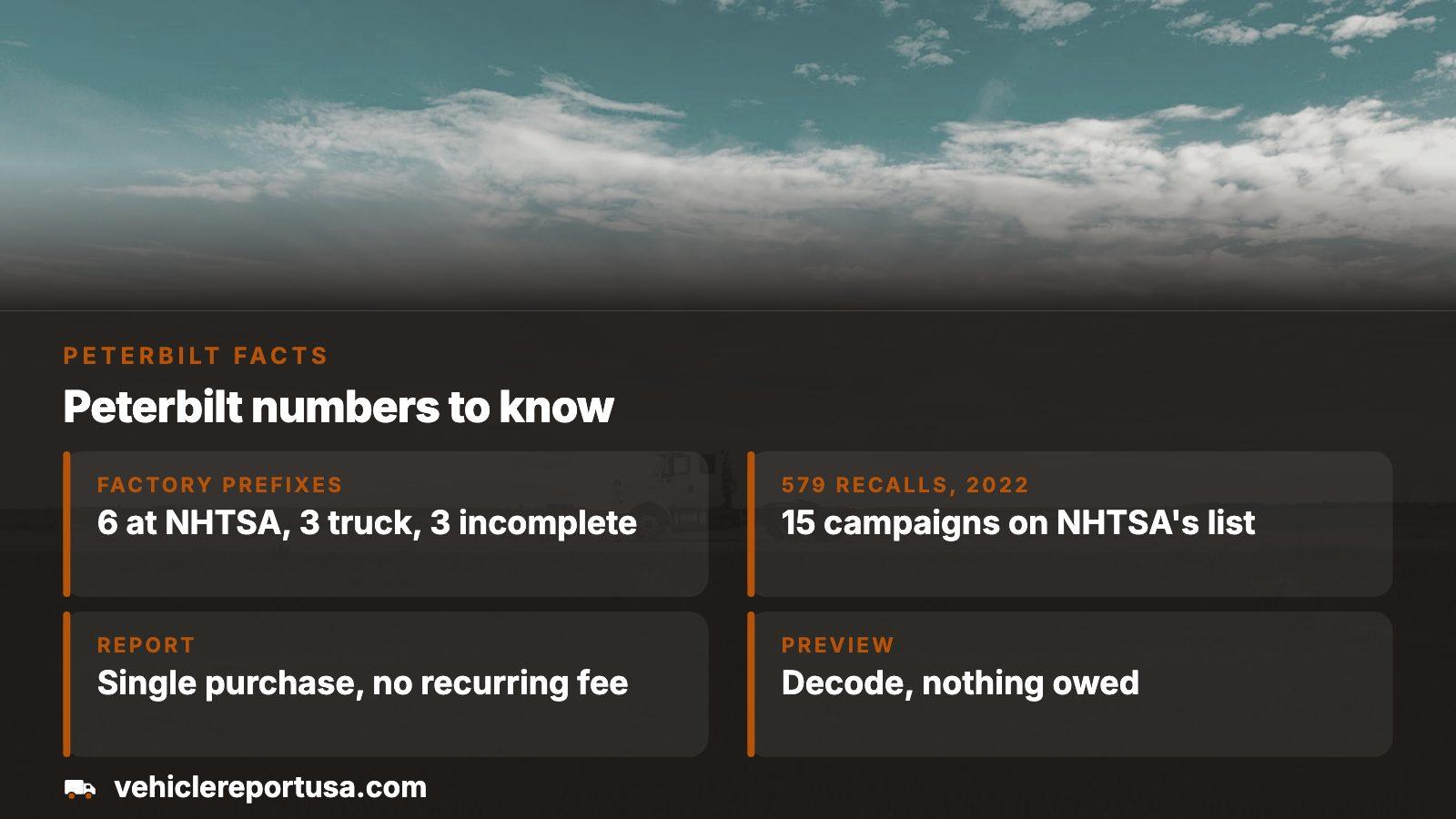
- Preview
- Free decode, nothing owed
- Report
- Single purchase, no recurring fee
- Peterbilt factory prefixes
- 6 at NHTSA, 3 truck and 3 incomplete
- 579 recalls, model year 2022
- 15 campaigns on NHTSA's list
What a Peterbilt history check actually looks up
VehicleReportUSA builds its checks around trucks, trailers, RVs and motorcycles, and a Peterbilt is the kind of vehicle where the history matters more than the odometer. A tractor can pass through a lease return, a fleet auction, a small carrier and an owner-operator before you see the ad. The VIN is the one thing that stays attached through all of it.
- Salvage, junk or flood brands, and insurer write-offs.
- Damage records, with auction photos when a unit was sold through a lot.
- Odometer readings recorded at sales and registrations.
- Liens, impound entries and theft reports.
- Open recalls that no dealer has completed.
Treat it as the first filter. It costs far less than a day of shop labor, and it removes trucks with a branded title or a mileage gap before anyone drives out to look.
The free preview, then one payment
Start with the preview. It decodes the number so you can confirm that the model, year and body match what the seller listed, and it costs nothing. On a Peterbilt, the paid part is the history report alone, bought once and never renewed. Buying for a small fleet? Report packs exist, with current rates on the pricing page.
A sensible order: preview every candidate, drop the ones where the decode disagrees with the listing, then buy a report only for the trucks still in the running.
Getting the number off the truck
Ask the seller to text you a picture of the VIN plate ahead of the trip, then match it to the truck in person. On a Peterbilt, look in these places:
- The driver's side frame rail, where the number is stamped into the metal.
- The certification label in the door area of the cab.
- A second label near the first, if a body was fitted after the chassis left the factory.
- The title and registration, which should show the same 17 characters.
If the stamped number, the label and the paperwork do not agree, stop. That mismatch is a bigger problem than anything a report would find.

1XP or 1NP: reading the first three characters
NHTSA's vPIC register holds six factory prefixes under Peterbilt Motors Company. The three that begin with 1, 2 or 3 and end in XP or WP are complete trucks; the other three are incomplete vehicles, meaning chassis sold to another company to finish. Prefixes follow the region of assembly.
| Built in | Complete truck | Chassis only |
|---|---|---|
| US plant | 1XP | 1NP |
| Canadian plant | 2XP | 2NP |
| Mexican plant | 3WP | 3BP |
Why it matters when buying: a dump, mixer, wrecker or crane truck on a 1NP chassis has two builders. The recall list and records tied to the chassis number say nothing about the body, so ask the seller for the body maker's paperwork too. A sleeper tractor on a 1XP number is the simpler case.
How many recalls the popular models carry
NHTSA's recall data returns a different number of campaigns depending on the model and year. These counts come straight from its recalls API:
| Model year | 579 | 567 | 389 |
|---|---|---|---|
| 2016 | 11 | 10 | 8 |
| 2018 | 14 | 13 | 6 |
| 2020 | 6 | 8 | 5 |
| 2022 | 15 | 10 | 7 |
A count says little by itself, since many campaigns are narrow and a dealer may have closed them years ago. What you want to know is which ones are still open on your VIN, and the report lists those.
A sample: recalls on a 2018 Peterbilt 579
PACCAR files most of these notices, and they often name Kenworth trucks in the same text. For a 2018 579, the list includes the following.
| Campaign | Problem | Fix |
|---|---|---|
| 18V931000 | Clutch assembly part may fail on automated manual transmissions, so the truck could move unintentionally | Dealer updates the transmission control module |
| 18V368000 | ABS warning light may stay off after the controller loses power | Dealer updates cab control module software |
| 18V870000 | Seat belt buckles may have been glued instead of sewn | Dealer replaces the buckle assemblies |
| 17V103000 | Plastic fuel tee fittings may leak | Dealer replaces the fittings |
Every one of these repairs is free at the dealer. One oddity: campaign 19V657000 appears under the Peterbilt name but was filed by a company that built electric trucks on a 579 chassis, which shows that the maker is not always the filer.
What owners told NHTSA
From an NHTSA owner complaint
In a filing with NHTSA, a 2018 579 owner said the main wiring harness under the cab had little or no protective wrap and ran against metal parts, so the wires frayed. It surfaced when a headlight died and the running lights stayed on, and the washer pump kept running until it was scalding hot. The owner raised fire risk and said warranty did not cover the repair.
Wiring faults like this leave no title entry and no accident record. Pull the cab panels and look at harness routing yourself.
From an NHTSA owner complaint
Owner of a 2022 579 got a notice of recall 24V190000, then had the truck downshift with warning lights on. The dealer found a failed gear shifter assembly and said the repair part was unavailable, so the truck went unrepaired. It had 220,536 miles at the time.
Until the repair is actually done, the campaign stays open on that truck, parts or no parts. Ask whether any fix is waiting on stock.
Mileage claims and the federal exemption
Under 49 CFR 580.17, a vehicle rated over 16,000 pounds gross weight is exempt from the odometer disclosure required at transfer. Most Class 8 tractors fall over that line, so a seller may never have signed a mileage statement for the truck you are looking at.
Odometer entries from past sales, inspections and registrations still help, and a report shows them in order. Be wary of a stretch where mileage is flat for years or drops. Title data for consumers comes through approved NMVTIS providers; the federal site says some well-known report sellers hand that data only to dealers.
Red flags on a Peterbilt record
- Any branded title, or a write-off recorded by an insurer.
- Auction photos of cab, frame or axle damage nobody told you about.
- Mileage that falls, or an unexplained gap between readings.
- An active lien or an impound entry that could block your transfer.
- A theft report on the number.
- A VIN prefix that disagrees with the listing, such as a 1NP chassis sold as a factory truck.
A lone flag deserves a direct question to the seller. Pile up two or three and the better move is to walk.
Price, then the shop visit
Decoding the Peterbilt number is gratis. Only the history report is charged, a single time, at the rate listed on the pricing page. When it arrives, compare it with the title and the stamped number, then schedule an inspection covering the engine, aftertreatment system, frame and fifth wheel. A clean record trims the odds of a bad buy but cannot stand in for a mechanic.
Where this information comes from
- NHTSA vPIC: Peterbilt manufacturer codes — the six factory prefixes and their classes
- NHTSA recalls API: Peterbilt 579 2018 — campaign numbers and remedies in the tables
- eCFR: 49 CFR 580.17 — the weight-based odometer disclosure exemption
- NMVTIS consumer site — purpose of the federal title system
- NHTSA owner complaint 11184671 — owner experience, paraphrased
- NHTSA owner complaint 11633660 — owner experience, paraphrased
Sources and photos: Facts checked against the sources above in November 2026. Photos by Willian Cittadin, JavyGo and Peter McCrae-Hokenson on Unsplash; diagrams by VehicleReportUSA.
Keep reading
- Kenworth VIN Check: What a Used Truck's Record ShowsThe other PACCAR marque, which shares many recall notices.
- Semi Truck VIN Check: Run a History on a Used Class 8 TractorSleeper tractors in general, with the same record checks.
- International Truck VIN Check: Isuzu, Hino and Dump Truck HistoryFleet use and commercial records explained.
- Truck VIN Lookup Specs: What the Decode Shows and Where It StopsFactory specifications you can pull from the number.
Frequently asked questions
Is a Peterbilt VIN lookup free?
A Peterbilt VIN decode costs you nothing and settles the model and year. The history report is the only charge, a single fee with nothing recurring, and the pricing page has the amounts. The federal recall lookup costs nothing as well, though it covers recalls only.
What do 1XP and 1NP mean at the start of a Peterbilt VIN?
Both are Peterbilt factory prefixes registered with NHTSA. 1XP marks a complete truck built in the United States, while 1NP marks an incomplete vehicle, a chassis that another company finishes with a body. Ask who built the body if you see 1NP.
Does the report show a Peterbilt's true mileage?
It shows the odometer readings that were recorded at sales, inspections and registrations, which lets you spot drops and long gaps. Heavy trucks above 16,000 pounds are exempt from the federal disclosure at transfer, so some have fewer entries than a passenger car.
Can I look up a Peterbilt by license plate?
No. This check starts from the 17-character VIN. A plate alone will not do. Have the seller send the 17 characters, or read them yourself from the frame rail, the door label or the title.
Will a clean report mean the truck is sound?
No. A clean record means no brands, damage entries or liens were found. It cannot show engine wear, a worn clutch, frame repairs without a claim, or wiring problems. Pair it with an inspection by a diesel shop.
Now check the car itself
The guide explains what to look for. The report shows what this VIN has on record.