THE SHORT ANSWER
Type in the bus's VIN and read the preview. For each bus still in contention, buy the single-payment report. Read the title brands, crash and auction entries, odometer figures, liens, theft flags, use type and any open recalls. Fleet buses often have few owners and sparse mileage records, and nothing in a database shows rust, worn brakes or a flooded wheel well, so pair the report with an inspection.
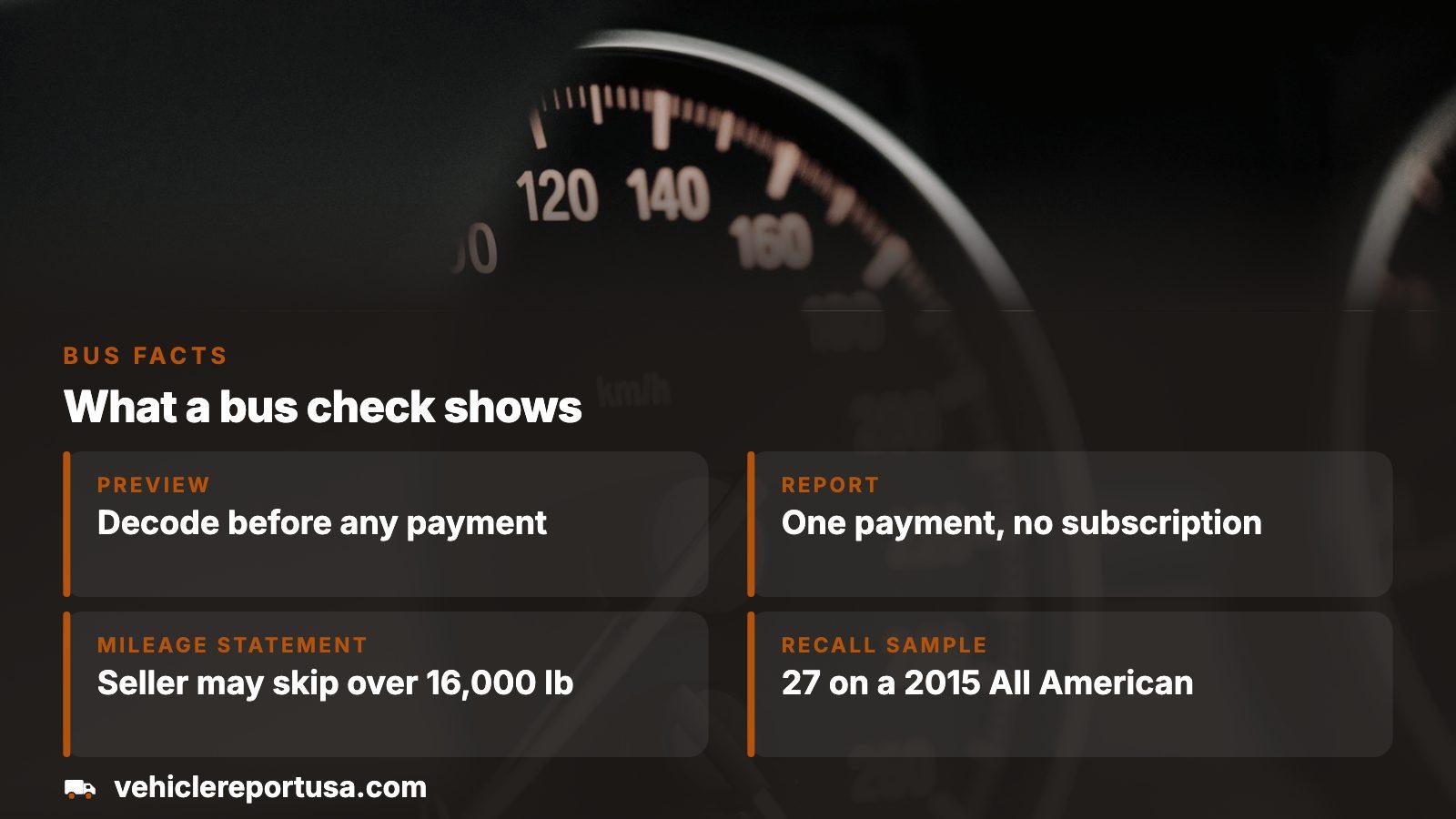
- Preview
- Free decode before any payment
- Report
- One payment, no subscription, packs available
- Mileage statement
- Seller may skip it over 16,000 lb
- Recall sample
- 27 campaigns on a 2015 Blue Bird All American
What the lookup tells you about a former school bus
Most buses on the used market spent their first decade with one school district or one contractor. That makes the history different from a pickup's: fewer owners, more use type labels, and a lot of silence between the first sale and the auction lot. The report can put these in front of you.
- Title labels like flood, salvage or junk, plus any insurer total-loss entry.
- Damage and auction records, sometimes with sale photos of the body and undercarriage.
- Odometer readings from earlier title events, which expose a rollback or a long stretch with none.
- Liens, impounds and theft flags, any of which can stall a transfer.
- Open safety recalls tied to the chassis or the body maker.
- Use type and ownership: fleet, government, private or converted.
Anything that never reached a title office or an insurer stays invisible. Nobody reports a district's own garage repairs.
Two makers, two labels, one VIN
Federal rules treat a bus as a vehicle carrying more than ten people, and a school bus as one sold for carrying students to school or school events. Plenty of them are built in stages: a chassis maker finishes the frame, engine and cab, then a body builder adds the passenger compartment. Under the federal label rules, each stage gets its own label, and the company that finishes the bus is the one certifying it.
NHTSA's decoder shows how mixed this gets. The same maker can appear as a truck, a bus, a multipurpose vehicle and an incomplete vehicle, and its model list includes a chassis-only entry. If the decode on your bus says incomplete vehicle or truck, that is not automatically an error. Match it against the label on the bus and ask the seller which company built the body.
Where to read the VIN on a bus
Start at the driver's door area. Federal rules put the certification label near the driver's seat, usually on the hinge pillar or latch post, and it is riveted on so it cannot be peeled away. The VIN is also stamped on the chassis and printed on the title and registration.
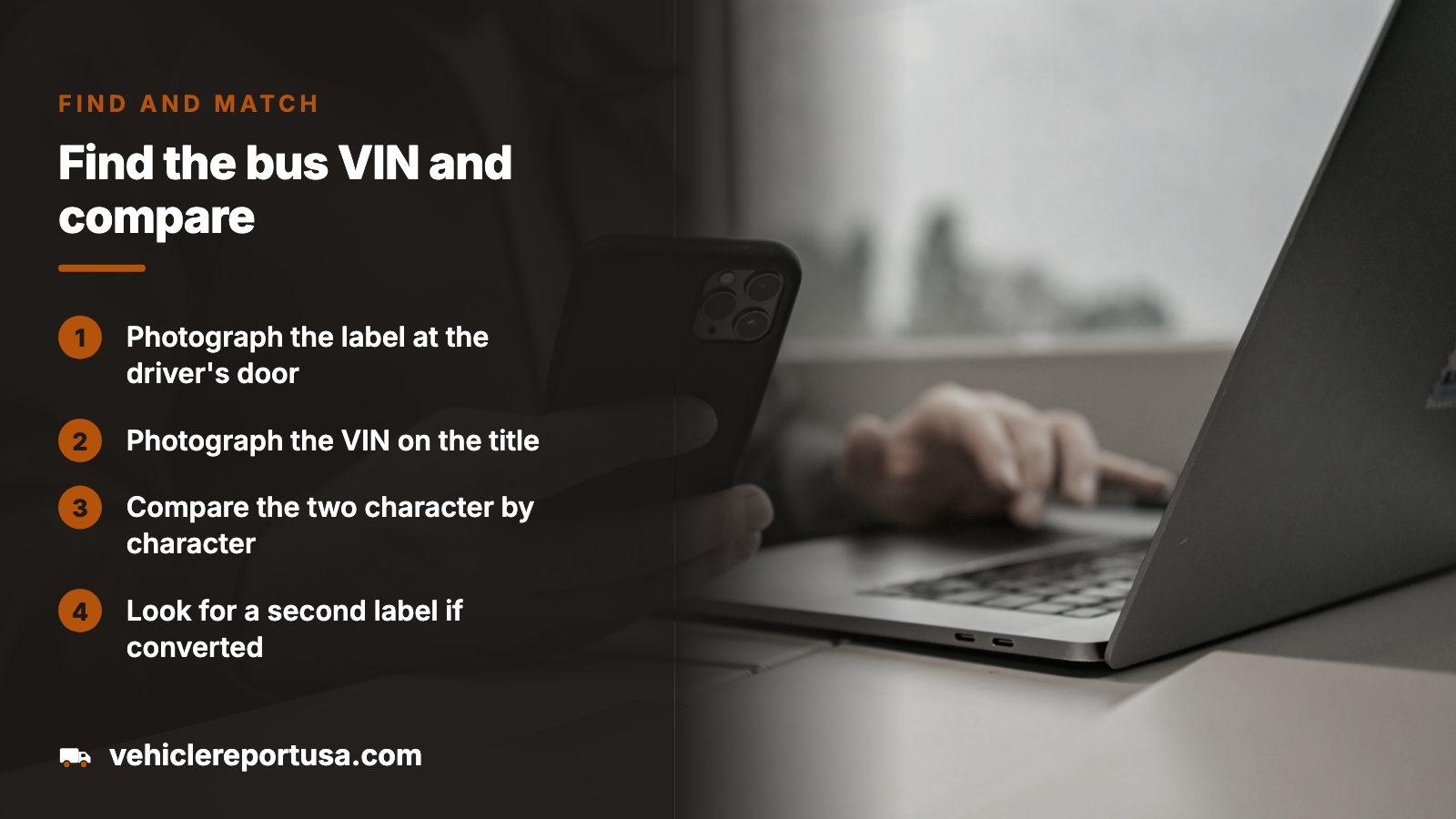
- Photograph the label at the driver's door, with the manufacturer name and weight rating in frame.
- Photograph the VIN on the title or registration.
- Compare the two, character by character.
- If the bus was converted, look for a second label from the converter and check that nobody painted over the original.
A label that has vanished, been painted over or contradicts the paperwork calls for a written explanation first.
What recall history looks like on one bus line
To see how deep school bus recall files run, I pulled the federal record for the 2015 Blue Bird All American. NHTSA lists 27 campaigns against that model year, and many were issued for several years of Vision and All American buses at once. Three examples:
| Campaign | Problem | Remedy |
|---|---|---|
| 14V798000 | Parking brake pedal on buses built July 8 to September 22, 2014 could separate and bend | Inspect the date code, replace the pedal assembly |
| 19V391000 | Bendix ADB22X air brakes could drag on the driver-side rear wheel, with a fire risk at the wheel end | New caliper with updated clearance adjustment |
| 20V125000 | Seat barrier behind the driver may be missing a reinforcing bracket, which fails the seating standard (FMVSS 222) | Inspect, install barrier and bracket |
Remedies were free to owners, but only if the bus is still enrolled with the maker. A retired bus that changed hands twice may never have received the notice. Run the VIN, then ask the seller to document how each open campaign was closed.
What owners report once a bus is in service
NHTSA also logs owner complaints, and the three filed for that same 2015 model year show the range: steering noise on left turns, loose fuel tank bolts found at the dealer, and a coolant leak.
From an NHTSA owner complaint
A complainant wrote that a school bus kept leaking coolant into the passenger area, the engine bay and onto the pavement, even after repeated trips back to the dealer. The filer worried about children and slippery floors. No crash, fire or injury was reported.
Take this from it: a leak that survives several repair visits belongs in your inspection notes. A report cannot see it, so ask the district's service records and put your own flashlight under the floor.
Mileage, titles and what NMVTIS adds
Under federal odometer rules, a seller can leave out the mileage statement for a vehicle rated over 16,000 pounds, on an older vehicle past a set age, and on a bus sold direct by its maker to a federal agency under contract specifications. Many full-size buses clear that bar, so a thin or empty mileage record can be normal and tells you less than it would on a car.
Title data comes through NMVTIS, the federal system holding the current title, the newest odometer figure, past brands and, at times, theft entries. States brand differently, so a clean federal view does not replace a call to your own title office. A bus that sat through a flood or fire should show a brand, but unreported damage never will.
Red flags specific to buses
- A flood, salvage or junk brand on a bus sold as well kept by a district.
- A mileage reading that falls between two records, or a bus with no readings at all and a seller who cannot produce service logs.
- A VIN that decodes to a different weight class or body type than the label shows.
- An open recall on brakes, steering or seat anchors.
- A lien or impound entry that the seller has not mentioned.
- A converted bus whose body no longer matches the title's use type.
None of these ends a deal by itself. Each one is a question the seller should answer with paper, not a promise.
Licensing and use rules before you drive it home
For commercial licensing, federal rules define a school bus as a commercial vehicle carrying pre-primary, primary or secondary students to and from school or school-sponsored events. The same rules list a separate school bus endorsement, and it is distinct from the passenger endorsement. A converted bus used as a home or camper falls under your state's rules instead, so ask your motor vehicle office how it classifies the vehicle before you pay.
Weight rating matters here too. The seating standard splits buses at 10,000 pounds, which is the line between small and large school bus rules. Read the door label to learn which side your bus falls on.
Cost and next steps
The decode preview is the part that costs nothing. Beyond it, one payment buys a report, with no subscription, and packs exist for comparing several buses. The current prices are on the pricing page.
Run your shortlist in this order: preview, report on the finalists, recall check on the maker's own lookup for the same VIN, then a mechanic who works on air brakes and diesel drivetrains. Keep the printed report with the bill of sale.
Where this information comes from
- 49 CFR 571.3, definitions (eCFR) — the federal meaning of bus and school bus, and what a weight rating is
- 49 CFR 567.4, certification label (eCFR) — where the label sits at the driver's door and how it is attached
- 49 CFR 580.17, odometer exemptions (eCFR) — weight and age lines for the mileage statement
- 49 CFR 383.93, CDL endorsements (eCFR) — the separate school bus endorsement
- NMVTIS for consumers (BJA) — what the federal title database holds, and where states handle brands differently
- NHTSA recalls — recall records by VIN and by make, model and year
- NHTSA owner complaint 10716658 — owner experience, paraphrased
Sources and photos: Facts checked against the sources above in November 2026. Photos by Nikolai Kolosov, Anastasiia Nelen and CHUTTERSNAP on Unsplash; diagrams by VehicleReportUSA.
Keep reading
- International Truck VIN Check: Isuzu, Hino and Dump Truck HistoryHeavy chassis, fleet histories and weight ratings get a wider walkthrough there.
- Box Truck VIN Check: Run the History Before You Buy OneAnother body-on-chassis vehicle where two builders share one history.
- Motorhome VIN Check: Run the Chassis Number Before You Buy a CoachUseful if the bus is headed for conversion into a home on wheels.
- Food Truck VIN Check: Read the Vehicle's History FirstSame questions about conversions and use type for a work vehicle.
Frequently asked questions
Can I look up a school bus by VIN?
Yes. Enter the 17-character VIN for a decode at no cost, then buy the report for brands, damage, readings, liens and open recalls. Buses built in stages may decode as a truck or an incomplete vehicle, so match the result to the door label.
Where is the VIN on a school bus?
Look beside the driver's seat first, where the permanent label is normally fixed to the pillar or latch post. The title and registration also print it. If the two disagree, hold off on buying until the seller accounts for it.
Will a report show the miles a district put on the bus?
Only readings that reached a title office, auction or insurer. Heavy buses can change hands with no mileage statement, so gaps are common. Ask for the district's maintenance records and compare them with the dashboard reading.
Does an open recall mean I should walk away?
Not by itself. Recall repairs are done at no charge when the bus qualifies, so what matters is whether the repair actually happened. Ask for proof, or have a dealer for that maker confirm the campaign status against the VIN.
Do I need a special license to drive a former school bus?
It depends on the weight rating and how you will use it. Federal rules define a school bus endorsement for student transport. A private conversion has its own state rules, so ask your motor vehicle office what applies to your bus.
Now check the car itself
The guide explains what to look for. The report shows what this VIN has on record.