THE SHORT ANSWER
Copy the VIN from the plate-style certification label near the front of the driver-side wall, all 17 characters, and run it. The free preview decodes it. The paid report then searches title brands, damage, liens, theft and open recalls. Many teardrops come from tiny builders, so records run thin, and a short result means look harder rather than relax.
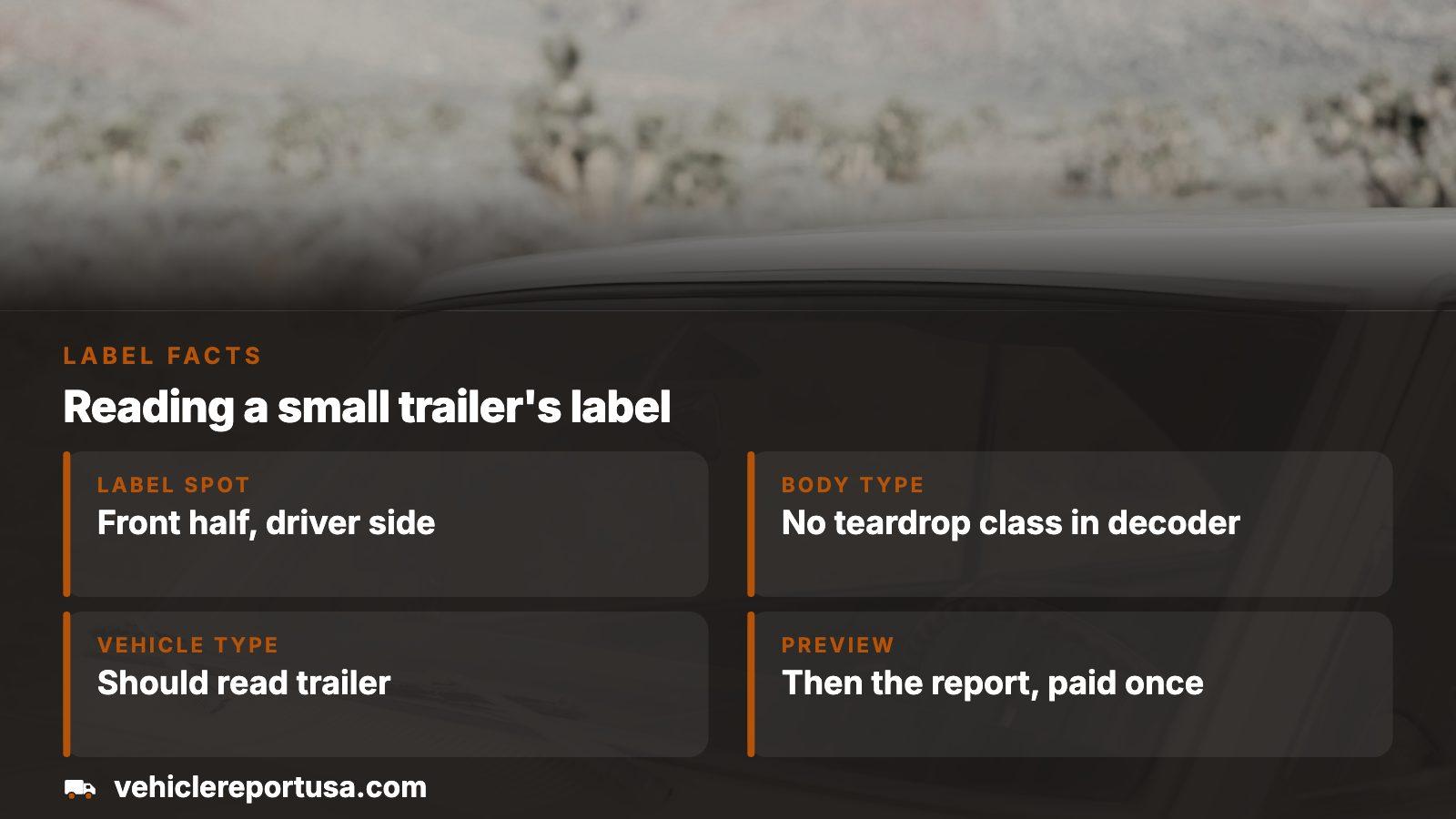
- Label spot
- Front half, driver side
- Teardrop body type in the decoder
- None; closest is camping or travel trailer
- Teardrop-named trailer makes in vPIC
- 31
- Preview
- Free; the report is one payment
Why a small camper still deserves a history check
A teardrop looks harmless: a sleeping pod on a single axle that a midsize car can tow. That is exactly why they get passed around quietly, through a classified ad, a driveway handshake or a club forum. Nobody at a dealership is pulling a record for you.
Of everything on a camper, only the VIN stays with it through each sale. A search can show a salvage brand, a paid claim, a lien still on the title or a theft entry, and whether the number matches what the seller says the camper is. It cannot replace crawling underneath with a flashlight, but it tells you what to ask first.
VehicleReportUSA focuses on vehicles outside the ordinary sedan market. A teardrop sits in the oddest corner of that group, because the builders are small and the paperwork varies.
Finding and reading the number on the trailer
Federal rules say a trailer's certification label belongs toward the front of the driver's side, readable from outside with nothing moved or opened. It must be fixed so that peeling it off would wreck it. On a teardrop, look at the front of the left wall, close to the tongue.
- The builder's name, often after the words Manufactured By
- Month and year of manufacture
- Gross vehicle weight rating and the rating for each axle
- The 17-character VIN
- The vehicle type, which should read trailer
Photograph the whole label and type the VIN from the photo, not from a text message. If the number on a teardrop's frame contains an I, an O or a Q, it was copied down wrongly, since those three letters are left out of every genuine VIN. A missing, painted-over or re-riveted label is a finding by itself; read our guide on a trailer with no VIN before going further.
What the free decoder can and cannot tell you
The decoder at NHTSA works from maker-reported data. For a teardrop that data is uneven. NHTSA's trailer body type field has 29 choices and none is called teardrop; the nearest is camping or travel trailer, so a decode may describe your pod in generic terms.
| Decoder item | What to expect on a teardrop |
|---|---|
| Make and model | Usually right if the builder filed with NHTSA |
| Model year | Taken from the tenth character; confirm it against the label date |
| Body type | Camping or travel trailer, or a generic entry |
| Length and axles | Present only if the builder filed them |
| Plant | Often a single small shop |
Treat a mismatch as the useful result. If the label says one builder and the decode names another, or the year on the label is far from the year the number implies, ask the seller to explain before you spend more time.
A field of tiny builders
On the day we looked, NHTSA's vehicle database listed 9,614 trailer makes. Thirty-one of those carry the word teardrop in the name, from Colorado Teardrop Trailers to So-Cal Teardrops, and that count ignores names like Little Guy Max, Taxa and NuCamp that build the same style of camper without it.
That spread matters. A household-name builder leaves recalls, owner complaints and dealer service records. A one-person shop may leave a label and an invoice. With a small maker, the search leans on title, lien and insurance entries rather than anything the builder filed.
Responsible manufacturer wording
A federal rule lets a company that builds trailers but did not make this one appear on the label as Responsible Manufacturer, or Resp Mfr. On a rebadged or resold teardrop, expect to see that phrase and ask who actually welded the frame.
The records the check searches
A teardrop has no odometer, so mileage stays blank. The sections that matter for a camper this size are these.
- Title brands: salvage, rebuilt or flood labels that stay with the number
- Damage and salvage photos: a folded frame or water line the listing never mentioned
- Liens and impounds: money still owed, or a past tow-and-hold
- Theft and insurance: a stolen-unit entry or a paid claim
- Open recalls: campaigns the maker has not yet closed on this unit
- Value: a market figure to test the asking price against
Flood is the brand to care about most in a pod with plywood and foam inside the shell. Water that got in once can sit behind a galley wall for years.

Coverage gaps and the false negative
The Justice Department's NMVTIS consumer page puts the system at 87 percent of vehicles nationally, with just over half the states feeding it, and warns that a search may return a falsely clean result until every reporting party participates. Reporting is mandatory for common automobiles; the page mentions motorcycles and heavy equipment as extras some states add, and does not name trailers.
So read an empty result for what it is: nothing was found, which is different from nothing happened. States also disagree about when a damaged vehicle gets a brand, and a visit to a salvage yard does not force one. A homebuilt or kit teardrop may have been titled once, from paperwork the builder wrote, with little behind it.
For a pod that cost real money, add the state's own title record and the bill of sale to the VIN search.
Recalls on teardrop-style campers
Recalls on this kind of camper are rare in NHTSA's data. We pulled the lists of makes with recall records for model years 2014, 2016, 2018, 2020, 2022 and 2024 and found no teardrop-named maker in any of them. Taxa shows up for 2022 and NuCamp for 2024.
A recall that did exist
Campaign 24V579000 covers certain 2021 to 2024 Taxa Mantis trailers. Gaskets and brackets holding the freshwater tank could fail, letting the tank shift and drop off, which NHTSA says makes it a road hazard. The remedy is a dealer replacement of the gaskets and brackets at no charge.
Do not assume silence means safety. Small builders are not always in the recall system, and a make with no campaigns on file may simply never have had one reported. Ask the seller for the maker's contact details, and look the make up in NHTSA's recall search by year, make and model.
Red flags to act on
- The label is missing, scratched or sits somewhere other than the forward left side.
- The year on the label disagrees with the year the VIN implies.
- A lien is listed and the seller says the title is clear.
- A salvage, rebuilt or flood brand shows up on a unit sold as clean.
- The builder named on the label does not match the one in the ad.
- The seller refuses to let you photograph the label or see the title.
A single one of these should make you stop and look closer, and two at once mean you should leave the deal. An unpaid lien is the costliest surprise, since it can follow the trailer to you.
Cost, and your next move
Seeing what a teardrop's VIN decodes to costs you nothing. Paying for the full report covers one trailer only, packs of more reports are offered to people comparing several campers, and no subscription is involved. What it costs today is shown on the pricing page.
Run the preview from the seller's driveway if you can. If it decodes and matches the label, buy the report before making an offer. Then see the title in hand, look underneath for weld repairs and fresh undercoating, and compare any open recall with the maker's remedy.
Where this information comes from
- NHTSA vPIC: trailer makes list — Where the make counts and the body type options for trailers come from.
- eCFR: 49 CFR 567.4, certification label — Label placement on a trailer, how it is attached and the Responsible Manufacturer wording.
- NMVTIS consumer information (U.S. Department of Justice) — Coverage figures, reporting rules and the warning about false negatives.
- NHTSA recalls — Where to search a recall by VIN or by year, make and model.
Sources and photos: Facts checked against the sources above in November 2026. Photos by Dimitri Karastelev, Jakub Żerdzicki and Wesley Tingey on Unsplash; diagrams by VehicleReportUSA.
Keep reading
- Where Is the VIN Number on a Trailer? Label, Frame and TongueMore detail on locating and reading the label.
- What If a Trailer Has No VIN Number? A Buyer's ChecklistWhat to do when the number is missing or looks altered.
- Pop Up Camper VIN Check: Roof Lifts, Recalls and Title HistoryAnother lightweight camper type with its own record quirks.
- Travel Trailer VIN Check: Run the History Before You Buy the CamperThe same check for a full-size towable camper.
Frequently asked questions
Does a teardrop trailer have a VIN?
A trailer built to the federal rules carries a 17-character number on its certification label. Homebuilt or kit units may have a state-assigned number instead, and very old ones may use a shorter format. If you cannot find any number, resolve that with the state before buying, because the title cannot be searched without it.
Can I check a teardrop trailer for free?
NHTSA's decoder and recall search cost nothing and show maker-reported details and recall campaigns. The decode preview here carries no charge either. The report that searches title, damage and lien records is paid, a single purchase.
What if the report comes back empty?
It may mean the unit has a clean past, or it may mean records were never filed. Small builders and trailer titles are thinly covered. Confirm with the state title record, the bill of sale and an in-person inspection.
Do teardrop trailers get recalled?
Seldom, judging by NHTSA's data, and the few campaigns are tied to larger makers such as a tank-mounting recall on the Taxa Mantis. Lack of a recall does not prove a trailer is sound.
Is the VIN the same as the serial number?
On a trailer built to federal rules, the 17-character VIN is the number to use. Some small builders also stamp their own serial or build number on the frame. Record both, and make sure the VIN is the one on the title.
Now check the car itself
The guide explains what to look for. The report shows what this VIN has on record.