THE SHORT ANSWER
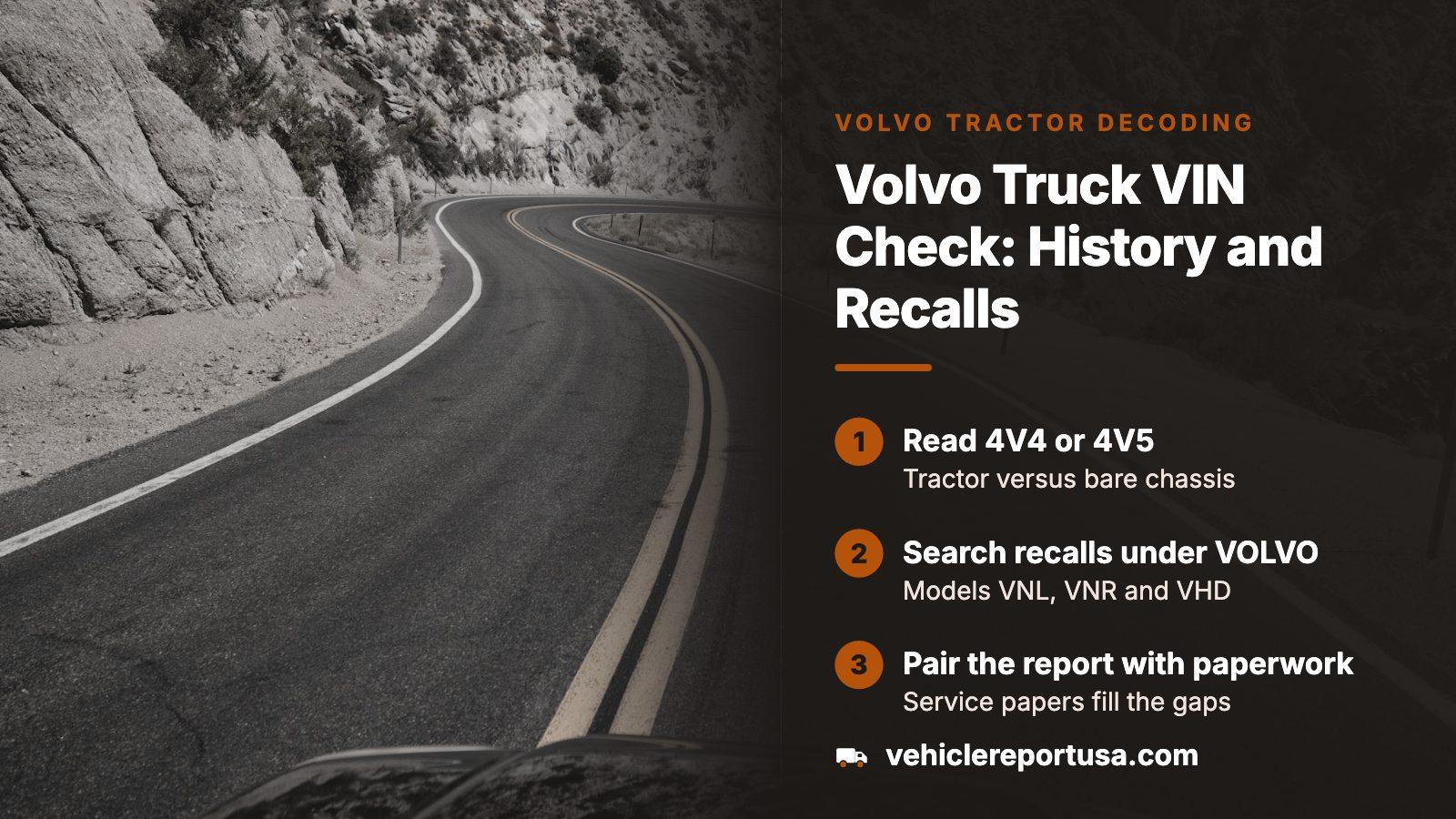
Copy all 17 characters from the certification label by the driver's seat and run them through the free preview. A Volvo tractor usually starts 4V4, while 4V5 means a bare chassis later completed by a body maker. The paid report then looks for title brands, salvage or auction records, past mileage readings, liens and open recalls. Heavy-truck data is thinner than car data, so pair the report with service papers and a shop inspection.
- Common tractor prefix
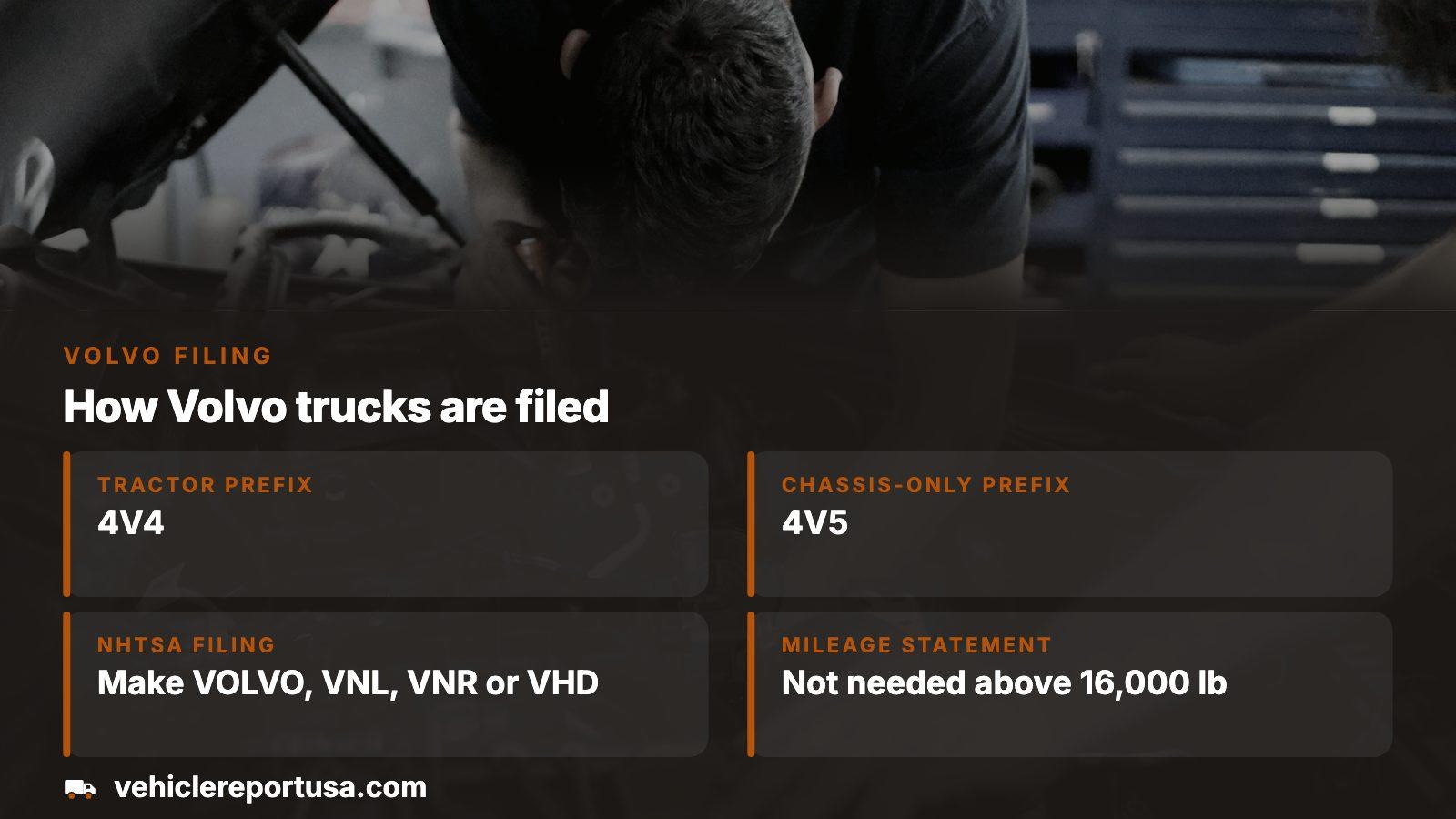
- 4V4
- Chassis-only prefix
- 4V5
- NHTSA filing name
- Make VOLVO, model VNL, VNR or VHD
- Mileage statement
- Not required above 16,000 lb
What a history search can turn up on a used Volvo tractor
Buyers of a used Volvo tractor are weighing a work truck, so the questions are blunt. Was it written off, did it cross an auction block, did the dash number ever read higher, is a payoff still outstanding? Running the VIN pulls whatever those records hold.
| Question | Source of the answer |
|---|---|
| Was it junked, salvaged or flooded at some point? | Brands a state applied, plus insurers' write-off reports |
| Did the odometer ever read higher? | Mileage recorded at earlier sales and title changes |
| Did it sell after damage? | Auction and salvage listings, with photos where they exist |
| Is money still owed on it? | Lender claims on file |
| Is a safety repair still waiting? | Open recall campaigns tied to the VIN |
Treat an empty result as good news, never as proof. The federal title system's own page warns that uneven state reporting can hide a brand.
Reading the front of a Volvo truck VIN
NHTSA's decoder files Volvo trucks under make VOLVO TRUCK and assigns eight truck prefixes to Volvo Group North America, 4V4 being the one most tractors carry. Volvo's car prefixes sit in the same list, so a 4V in front tells you it is a truck. Partial VINs from public owner complaints decoded like this:
| Truck | Prefix | What the decoder returned |
|---|---|---|
| 2019 VNL | 4V4 | Truck-tractor, Class 8, 6x4, Volvo D13 of 12.8 L, built at New River Valley in Dublin, Virginia |
| 2018 VNL | 4V4 | Same family, but a 6x2 drive and 13 L |
| 2013 VNL | 4V4 | Cummins ISX 15L under a Volvo hood |
| 2013 VNL | 4V5 | Incomplete chassis cab, flagged as possibly modified since it left the plant |
Engine and drive layout can differ between trucks sharing a model name, so confirm both against build papers. NHTSA also flags every partial VIN as incomplete and warns the model year may be wrong, so enter all 17 characters.
Where to find the number, and why one label is not enough
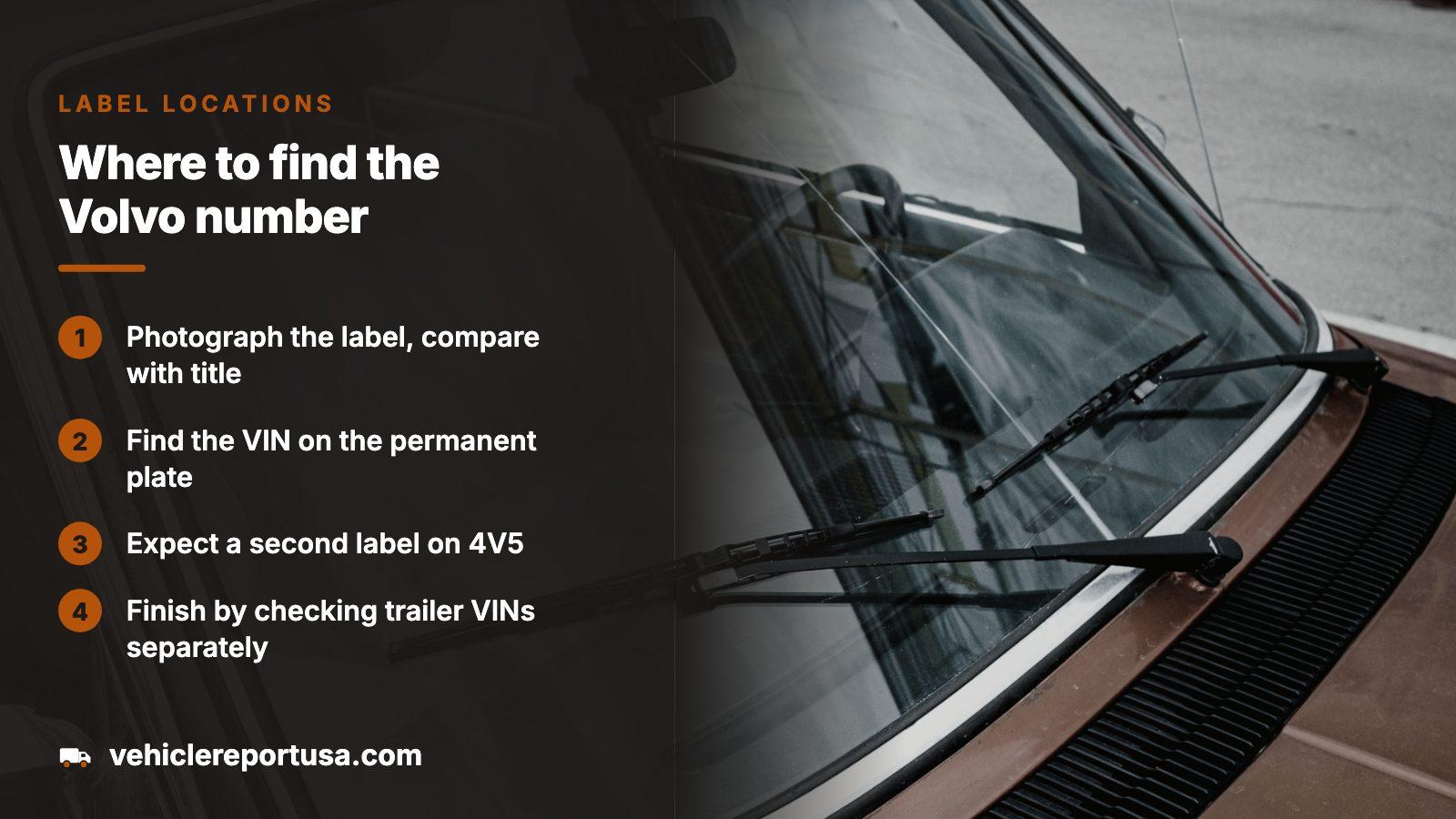
The maker's certification label is riveted or bonded beside the driver, on the door hinge post, the latch post or the door edge meeting it, so that prying it off wrecks it. Where none of those fits, the left side of the dash is next. The rule about reading a VIN through the windshield covers only lighter vehicles, so a Class 8 tractor may not show it there.
- Photograph the label, then check its VIN against the title and registration.
- Find the VIN on the permanent part or plate, which federal rules require on a component not meant to be removed.
- On a 4V5 chassis, expect a second label from whoever finished the truck, and ask about any gap between the two build dates.
The allowed character set leaves out three letters, I, O and Q, so a copied number holding one of them is a misread.
Recalls: Volvo trucks are filed under the car make
NHTSA's recall data lists Volvo Trucks North America campaigns under make VOLVO, the same make as the cars, with VNL, VNR or VHD as the model. Searching the make as two words returned nothing, so a blank result from a name search means little. Counts for the VNL by model year ran like this:
| VNL model year | Campaigns listed |
|---|---|
| 2013 | 14 |
| 2016 | 6 |
| 2018 | 5 |
| 2019 | 8 |
| 2020 | 9 |
| 2022 | 7 |
One campaign often names several models and years, so the totals overlap and a high number does not mean a worse truck. What matters is whether each campaign that fits your VIN was completed. The filings promise a repair at a dealer at no cost to the owner.
What nine campaigns look like on a 2020 VNL
The 2020 VNL list shows the mix to expect on a late-model tractor. Steering gear fasteners appear twice: campaign 19V756000 covered gears with insufficiently tightened mounting bolts, and 20V241000 covered loose steering gear fasteners on 2020 and 2021 trucks. Another, 20V536000, addressed a brake pedal plate that could break and dislodge the pedal.
Several are paperwork or small-part fixes. Campaign 20V384000 involved a certification label whose rear axle rating exceeded the wheel hubs' rating, with corrected labels as the remedy. Sleeper window hinges produced 19V208000 and 20V613000. Campaign 23V900000 named a single 2020 truck whose steering gear may have been built with too few recirculating balls.
That last one shows why a model-level search is not enough. Only a VIN lookup shows whether a one-truck campaign touches the unit in your yard.
What owners told NHTSA about used-looking trucks
Two complaints on 2019 VNLs show records a plain inspection can miss.
From an NHTSA owner complaint
A company-owned 2019 VNL at 409,228 miles started pulling hard to one side, and the driver had to turn the wheel well to the left to hold a line. The front axle U-bolts were found very loose, a state trooper put the truck out of service, and a shop later learned that no service or alignment had ever been done.
Takeaway: ask any seller for maintenance records at the axle, steering and suspension level. A clean title does not show whether basic hardware was ever checked.
From an NHTSA owner complaint
Another 2019 VNL threw an intermittent check engine light. Around 50 mph the driver saw smoke from the rear axle, stopped, tried to unhitch, and watched it turn into a fire. The truck was judged totaled and towed away, with no one hurt.
Takeaway: a written-off tractor can resurface for sale later, so look for total-loss or salvage entries and ask about warning lights that came and went.
Mileage, hours and the gaps in heavy-truck records
A seller does not have to state mileage on a vehicle rated over 16,000 pounds, which covers every Class 8 Volvo in the decoder trial. With no mileage statement on the title, an earlier recorded reading is the only outside check on the dash.
Federal title data also reaches common automobiles only, though some states report heavy equipment too. The department behind the system suggests requesting the state's own title file as well. For a long-haul tractor, also ask for the engine hour count and the service log, since those describe wear the odometer does not.
Results worth raising with the seller
- A brand, salvage entry or total-loss record on a truck advertised as clean.
- An auction listing shortly before the ad, with different mileage or damage photos.
- A dash reading lower than an earlier recorded reading.
- A 4V5 chassis with no second label, or an unexplained gap between build dates.
- An open campaign with no dealer paperwork on parts or scheduling.
- Steering, axle or suspension work with no repair order.
Any one of these justifies a direct question before a deposit changes hands.
Running it, and what it costs
- Copy the 17 characters from the certification label and match them to the title.
- Enter them to see the free preview of the truck's basics.
- Buy the report if the truck still fits. Payment is one charge, no subscription, for one report, or bundles of 3, 5 or 10 if you are shopping several rigs. Current rates sit on the pricing page.
- Run a trailer or second unit as its own VIN.
- Set the report beside the seller's story, then book an independent inspection.
Where this information comes from
- NHTSA owner complaint 11355359 — owner experience, paraphrased
- NHTSA owner complaint 11436407 — owner experience, paraphrased
- NHTSA vPIC: VIN decoder — how partial VINs and maker-reported data are handled
- NHTSA vPIC API: Volvo identifiers — truck and chassis prefixes assigned to Volvo Group North America
- NHTSA recalls API: Volvo VNL 2020 — campaign summaries and remedies behind the recall figures
- Vehiclehistory.gov: NMVTIS for consumers — what the federal title database covers and where it can miss
- eCFR: 49 CFR 580.17 — odometer disclosure exemptions by weight and age
Sources and photos: Facts checked against the sources above in November 2026. Photos by Will Truettner, Max Tokarev and Mustafa Sheikhmouss on Unsplash; diagrams by VehicleReportUSA.
Keep reading
- Semi Truck VIN Check: Run a History on a Used Class 8 TractorClass 8 tractors beyond Volvo: label spots, mileage gaps and open recalls.
- International Truck VIN Check: Isuzu, Hino and Dump Truck HistoryFleet and ex-lease trucks, and the paper a carrier should hand over.
- Freightliner VIN Check: Read a Truck's History Before You PayThe same checks on another big-name tractor line.
- Truck VIN Lookup Specs: What the Decode Shows and Where It StopsWhat a decode reveals about engine, axles and weight class.
Frequently asked questions
Is a Volvo truck VIN check free?
Only the preview costs nothing; it echoes the basics of the truck. The history report is a single paid purchase. NHTSA's decoder also takes a VIN, but it returns maker data and recalls, not title brands or auction records.
Does the VIN show which engine a Volvo truck has?
Often, but not always. The decoder named a Volvo D13 on most of the trial VINs and a Cummins ISX 15L on a 2013 VNL. Drive layout varied too. Confirm the engine against its own tag and the build paperwork.
Will a VIN check show the sleeper or body that was added?
No. A decode describes the chassis as the maker reported it, and a 4V5 result warns the truck may have been altered. The finishing builder's own label, its papers and a careful walk-around show the additions.
Why does a Volvo truck recall search sometimes return nothing?
NHTSA files Volvo trucks under make VOLVO with a model such as VNL, and searching the make as two words returned no results. A model-year search can also miss a campaign that names only certain trucks. Use the full VIN.
What if the VIN will not decode?
Go over each character; no VIN ever contains the letters I, O or Q. A partial number decodes only in part and may give the wrong year. On an older truck, match the number stamped on it to the title, then contact the maker.
Now check the car itself
The guide explains what to look for. The report shows what this VIN has on record.