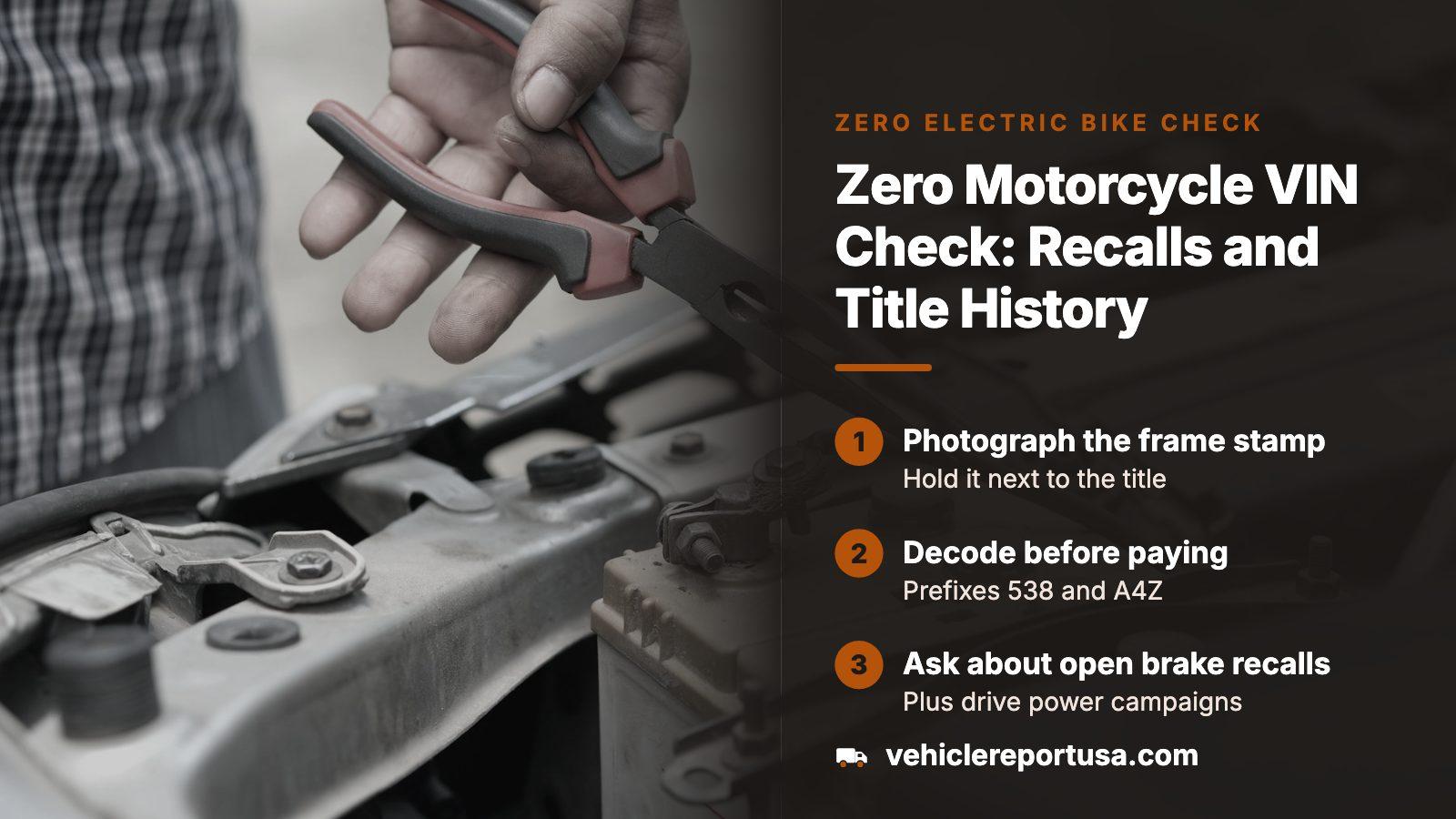
THE SHORT ANSWER
Shoot a photo of the frame stamping, hold it next to the title, and only then run the number. Zero numbers begin 538 or A4Z. You see the decode before paying; the paid report then adds title, damage, mileage, lien and theft entries plus open recalls. NHTSA data shows 14 Zero campaigns, mostly brakes and electrical.
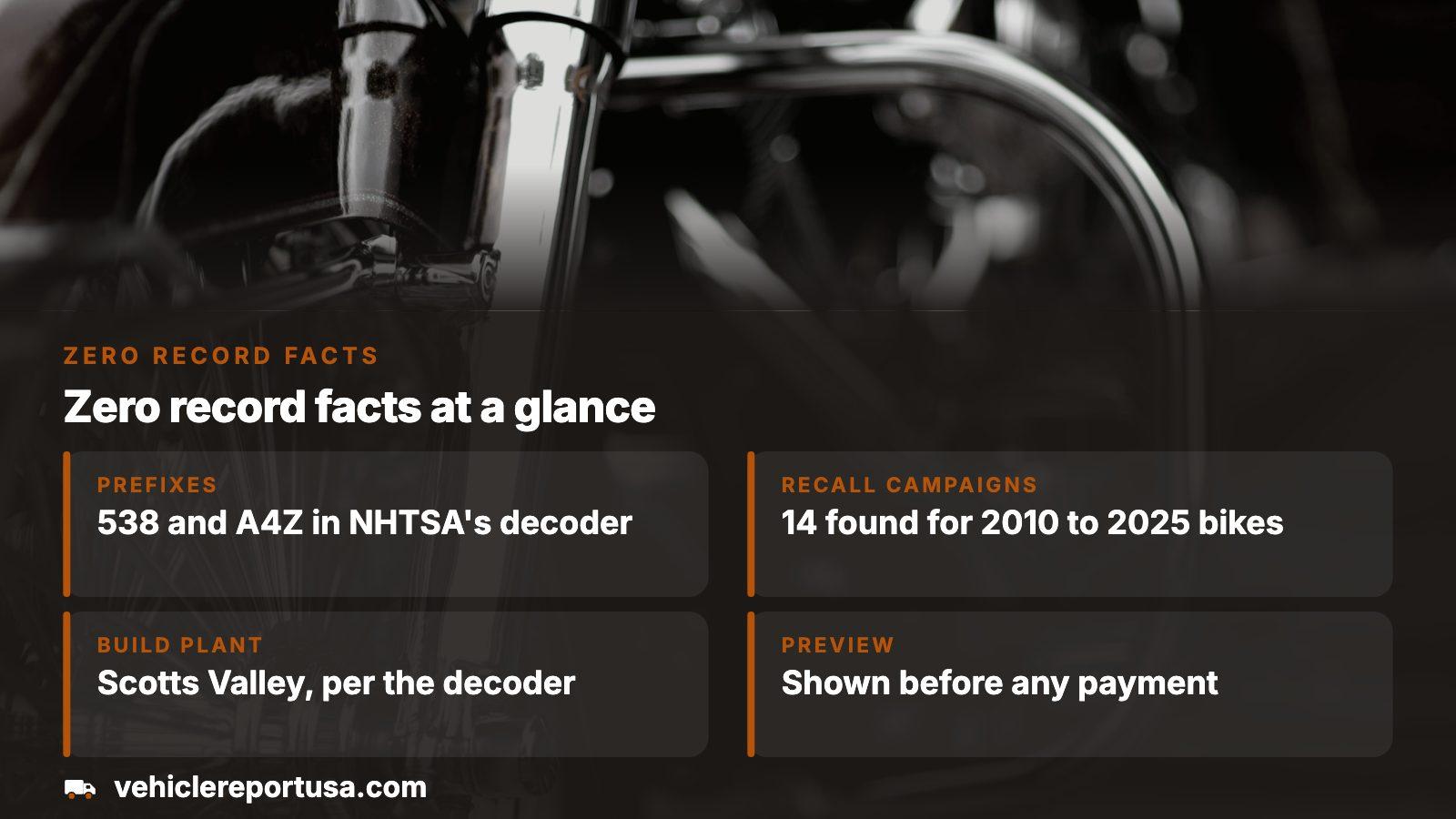
- Prefixes
- 538 and A4Z in NHTSA's decoder
- Recall campaigns
- 14 found for 2010 to 2025 bikes
- Build plant
- Scotts Valley, per the decoder
- Preview
- Free, before any payment
What a VIN check can and cannot tell you about a Zero
Much of what decides whether an electric bike is a good buy never reaches a database. Battery fade, motor wear and charging quirks stay inside the machine. A record search covers the paperwork side, which on a used Zero still carries weight. Look for:
- A rebuilt, salvage or similar stamp on the title, or an insurance write-off
- Damage entries and auction photos, useful on a bike that may have been laid down
- Mileage figures from several dates, which let you test a suspiciously low reading
- A lender's claim or tow-yard hold that would pass to you at purchase
- A stolen report, including on bikes that were later found
- Safety campaigns still unrepaired on that exact number
Two-wheelers are core business here, alongside heavy trucks, RVs and trailers, so a Zero gets a motorcycle-minded read. Treat the report as a filter for hidden history, never a stand-in for a test ride and a dealer diagnostic.
Reading the number before you pay for anything
NHTSA's decoder lists Zero Motorcycles, Inc. under two three-character prefixes, 538 and A4Z. Seven owner complaints I read, spanning 2012 to 2020, all start with 538, and the decoder reported electric power and a Scotts Valley plant.
Position ten is the year letter. These are the ones that appeared on the complaint VINs:
| Model year | Tenth character |
|---|---|
| 2012 | C |
| 2016 | G |
| 2018 | J |
| 2020 | L |
Hold that letter up against the listing. A gap of one year may just be a late build sold under the next label; anything wider deserves a written explanation. Federal rules also require characters four to eight on a bike to encode make, type, line, engine and power, and the encoded power can sit a tenth away from the real rating. For these electric bikes the decoder left horsepower empty, so lean on the model name instead.
Decoder results that look odd but are normal
Zero's naming is untidy. NHTSA carries 35 model entries for the make, from S, SR, DS and FX to XU, XB, XE, SR/F and SR/S, along with combined labels that bundle several trims. A decode may return a combined label and a platform tag, such as Z1 for the early S and DS family or Z4 for the SR/F, rather than one named trim.
A partial number returns a guess plus an incomplete-VIN warning, so type every character. One complaint I read sat under 2012 yet its year letter points to 2014. Database filing years prove nothing; the number stamped on your bike and printed on the title decide.
Recalls worth checking on any used Zero
NHTSA's recall data holds 14 Zero campaigns between the 2010 and 2025 model years, each with a no-charge dealer fix. Brakes and electrical parts dominate. These are the ones to raise with a seller:
| Campaign | Bikes covered | Problem |
|---|---|---|
| 11V282000 | 2009 and 2010 S and DS | Brake bracket could bend under hard stops and skew the pads |
| 14V119000 | Early-2014 builds of SR, S, DS and FX | Rotor dragging on the stator could seize the motor |
| 16V610000 | Some 2015 bikes | Underpowered converter could upset the ABS |
| 20V640000 | Some 2021 bikes | Converter margin too thin for ABS, lights and accessories together |
| 22V403000 | Some 2022 SR and SR/F bikes | Mismatched fork-side bolts could let the caliper work loose |
| 25V587000 | 2023 to 2024 DSR/X, 2024 DS family | Misrouted ignition wires could snap and kill drive |
A few fixes are software, and a dealer may push them over the air. Request the repair order from the seller, or have a dealer test the VIN against open campaigns.
What owners told NHTSA about used Zeros
Complaints are one-sided and seven records is a thin sample, yet they show where used-bike trouble tends to begin.
From an NHTSA owner complaint
A 2020 SR/F owner told NHTSA the bike ran 100 to 160 miles per charge when new in July 2020, then managed roughly 30 miles by February 2023. After tests by two dealers and a factory engineer, the manufacturer installed a new-chemistry battery in October 2023, with roughly 2200 miles showing. Range has held up since, the owner says.
A seller's claim about range proves little, so ride it down yourself and ask whether the pack was ever swapped.
From an NHTSA owner complaint
A 2020 FX owner described losing power at 45 mph with a heat warning lit. The dealer fitted a new motor under an extended warranty, the fault returned, and the owner says a third motor followed. A bad battery was then, by this account, not covered.
Ask to see the service paperwork, and confirm any warranty with the maker before counting on it.
From an NHTSA owner complaint
A 2018 S owner reported a failed DC to DC converter at under 1200 miles, which killed every light and the horn together. Converter problems appear in the recall list above, so test the VIN against them.
Running the check on a bike you are looking at
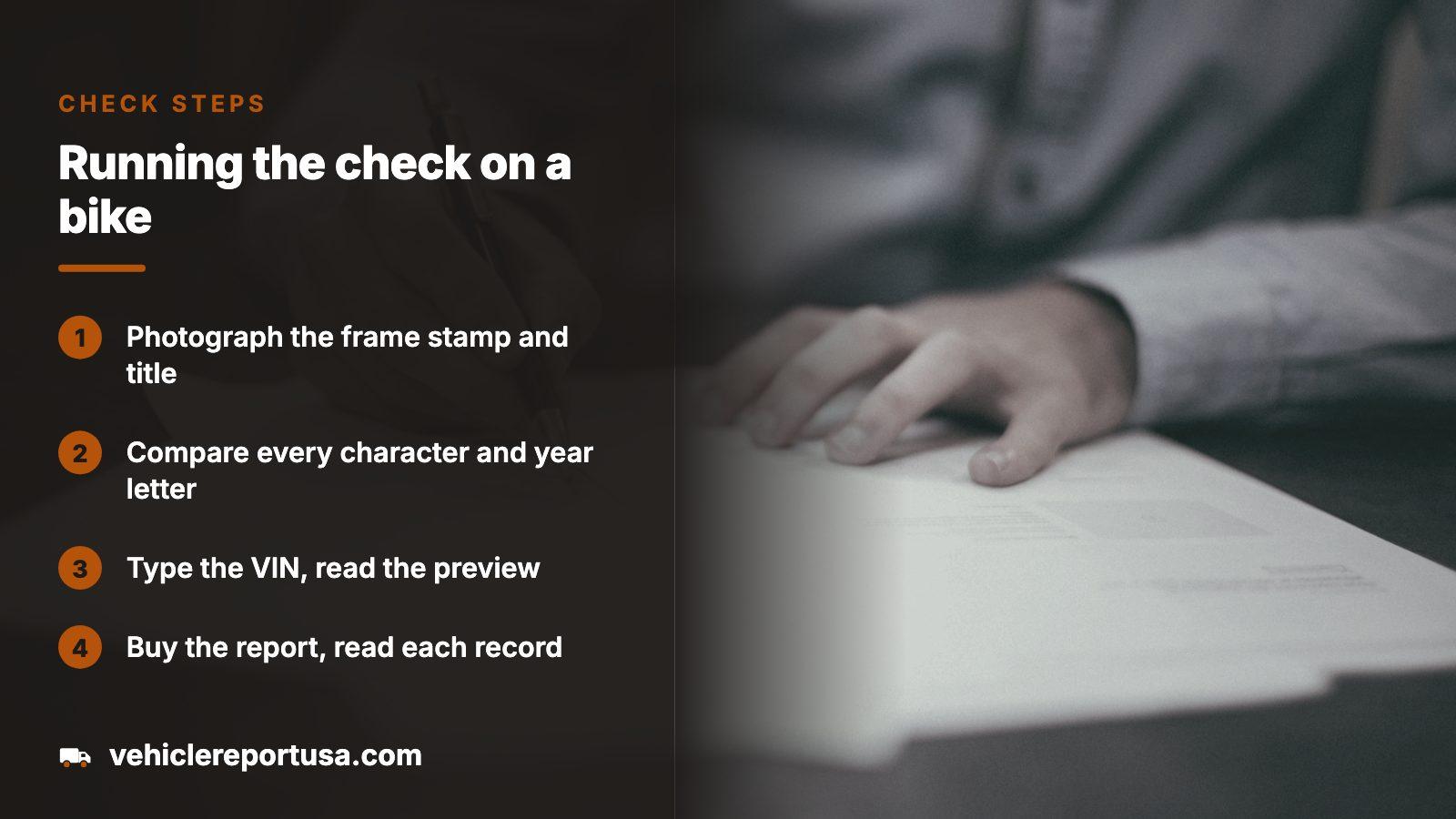
- Locate the stamped number on the frame and take a clear photo, then photograph the title's number.
- Compare every character, and check the year letter against the year in the ad.
- Type the VIN in for the free preview, which decodes model and year.
- Set the preview beside the listing; a different model, year or trim is a reason to pause.
- If it all lines up, buy the report and read each record before making an offer.
A number that is scratched, painted over or different from the paperwork is itself the result. Do not buy a bike whose identity the seller cannot account for.
Red flags in the results
- A title stamp or write-off entry the ad left out
- Auction photos with damage near the frame, forks or battery bay
- Mileage that drops or stands still between dates
- A brake, ABS or drive-power campaign still open with no repair record
- A loan still secured against the bike
- A stolen report or tow-yard entry
A single flag need not end a deal, but it should lower the price or close the conversation. A salvage stamp with no repair receipts belongs in the walk-away pile for most buyers.
Paying for the report, then the steps after it
Seeing the decoded Zero costs nothing. The full report is a single payment for one bike, or a bundle if you are weighing a few used Zeros against each other, and there is no auto-renewal. The pricing page has the amounts.
After the report, book a dealer inspection that reads the battery and fault history, run the VIN against open recalls, and have the title checked at your state motor vehicle office. Get the sale terms in writing, and keep the report with the receipt.
Where this information comes from
- NHTSA vPIC: Zero Motorcycles VIN prefixes — Source for the two prefixes, the plant and electric fuel type, and the model list.
- NHTSA recalls API: Zero campaigns by vehicle — Campaign numbers, covered bikes, defects and free dealer remedies.
- eCFR: 49 CFR Part 565 — The federal VIN rule for motorcycles: descriptor positions and the 10 percent power tolerance.
- VehicleHistory.gov: NMVTIS consumer page — What the federal title information system is meant to do for buyers.
- NHTSA owner complaint 11587697 — owner experience, paraphrased
- NHTSA owner complaint 11449555 — owner experience, paraphrased
- NHTSA owner complaint 11469631 — owner experience, paraphrased
Sources and photos: Facts checked against the sources above in November 2026. Photos by Towfiqu barbhuiya, Scott Graham and Steve Smith on Unsplash; diagrams by VehicleReportUSA.
Keep reading
- Motorcycle VIN Recall Check: Find Open Recalls on Any BikeHow to look up open recall campaigns on any bike and what to do about one.
- Motorcycle VIN Year Check: Confirm the Model Year Before You BuyReading the tenth character and the rest of the number to confirm a model year.
- Where Is the Motorcycle VIN Located? Frame, Label and Title MatchFinding the number on the frame when it is hard to spot.
- Motorcycle VIN Lookup: Check a Used Bike's History Before You PayThe general walk-through for any bike, from frame number to report.
Frequently asked questions
Does a VIN check show the battery condition on a Zero?
No. A history search covers records such as brands, crashes, mileage and recalls, not how much charge the pack holds. Ask for a full-charge range test, request service records, and have a dealer read the bike's diagnostics. Ask whether the pack was ever replaced and under what warranty.
What does a Zero VIN start with?
NHTSA's decoder lists 538 and A4Z for Zero Motorcycles, Inc. The seven complaint VINs I read all started 538. If a bike claims to be a Zero but the number starts with something else, ask for an explanation and the paperwork before going further.
Can I look up Zero recalls for free?
Yes. NHTSA publishes recall campaigns by make, model and year at no charge, and the maker can confirm whether a repair was done. The paid report adds title, damage, odometer, lien and theft records, so the recall check is one part of a wider screen.
Is a Zero motorcycle title the same as any other bike's?
Titles are issued by the state, and the same brand rules apply whatever powers the bike. A salvage or rebuilt brand follows an electric bike like any other. Confirm the number on the title matches the frame, and ask your state office about its transfer steps.
Is the Zero VIN check free?
Not entirely. The opening decode of the bike is free; the records behind it are a paid, one-off purchase that never renews. Amounts for one report or a bundle are listed on the pricing page.
Now check the car itself
The guide explains what to look for. The report shows what this VIN has on record.